 Discus
 Cichlids
 Angelfish
 Plecos & Catfish
 Community & Nano Fish
 Shrimp, Snails & Invertebrates
 Low-Tech Plants
 Medium-Tech plants
 High-Tech Plants
 Live Corals

 Terrarium Kits & Jars
 Terrarium Plants & Moss
 Bioactive Clean-up Crew


 Smart Control Systems
 Lighting
 Filtration
 Heaters
 Chiller & Cooling Fans
 Thermometers
 Air Pumps
 Wavemaker
 Protein Skimmer

 CO2 Diffusers
 CO2 Accessories & Drop Checkers
 Liquid Carbon & CO2 Alternatives





 Soil & Substrate
 Driftwood & Rocks
 Caves & Clays

 Filter Media, Sponge & Replacement Parts
 Tubing & Connectors



Best Low-Tech Aquarium Plants for Beginners

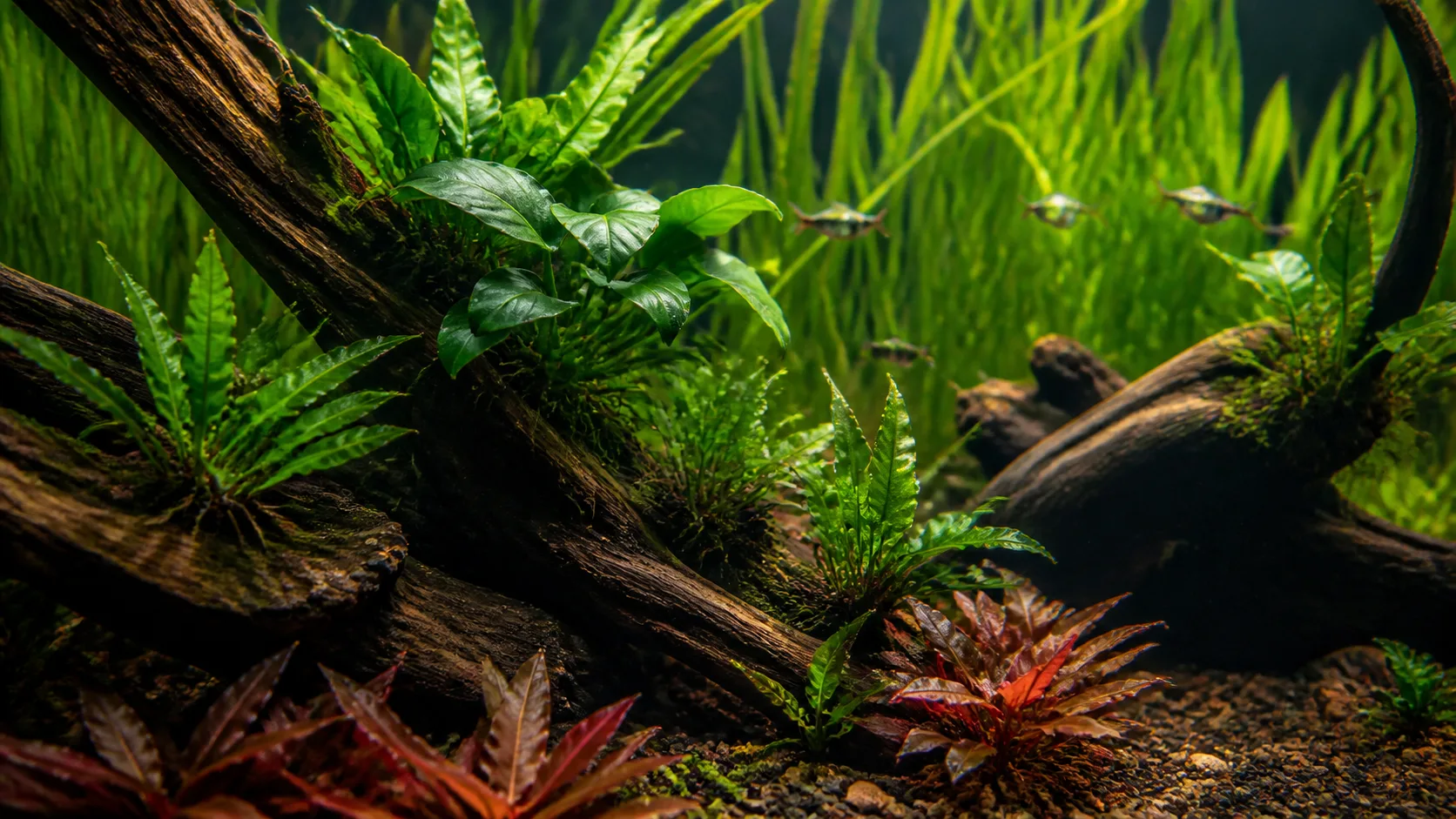
Best Low-Tech Aquarium Plants for Beginners
Table of Contents
- What “Low-Tech” Actually Means
- Anubias Nana: The Easiest Rhizome Plant
- Java Fern: Slow, Tough, and Nearly Indestructible
- Vallisneria: Fast Background Growth With No Fuss
- Cryptocoryne: Color and Texture Without CO₂
- How to Plant Rhizome vs. Rooted Species
- Light, Fertilizing, and Maintenance for Low-Tech Tanks
- Common Beginner Mistakes
- Frequently Asked Questions
What “Low-Tech” Actually Means
In the planted tank hobby, “low-tech” describes a setup that relies on moderate lighting and the nutrients naturally available in the water column and substrate — no pressurized CO₂ injection, no intensive dosing schedule. It’s the most beginner-friendly way to keep live plants, because the margin for error is much wider than in a high-tech, CO₂-injected tank.
The trade-off is growth speed: low-tech plants grow slower than their high-tech counterparts. That’s actually an advantage for a first planted tank — less trimming, less risk of a nutrient imbalance triggering algae, and a layout that stays looking the way you planted it for longer.
This guide focuses on four species that cover the two main planting styles you’ll encounter in the hobby — rhizome plants that attach to hardscape, and rooted plants that go into the substrate — so that by the end you’ll understand not just which plants to buy, but how to actually place them correctly the first time.
Anubias Nana: The Easiest Rhizome Plant
Anubias Nana is one of the most forgiving aquarium plants available, tolerating low light, a wide range of water parameters, and long stretches of neglect that would kill more demanding species. Its broad, dark green leaves and compact size make it a natural fit for the foreground or midground, attached to driftwood or rock.
Recommended Product
Anubias Nana tolerates a wide temperature range (roughly 22–28°C) and isn’t fussy about pH, which is part of why it works in so many different setups. It propagates on its own over time: as the rhizome grows, new leaf clusters and eventually side-shoots appear, which can be cut away with a clean blade and re-attached elsewhere once they have a few leaves of their own. Its broad leaves and slow growth also make it one of the few aquarium plants that tolerates being kept by shrimp-heavy or algae-eater-heavy tanks without being shredded.
Java Fern: Slow, Tough, and Nearly Indestructible
Java Fern is a classic Southeast Asian fern with long, soft green fronds. It grows extremely slowly, prefers low to moderate light, and — like Anubias — attaches to hardscape rather than being planted in substrate. That combination of low light tolerance and near-indestructibility makes it one of the safest first plants for a beginner tank.
Recommended Product
Java Fern’s slow growth (often just a few new fronds per month) means it rarely needs trimming, which is part of why it’s such a low-maintenance choice. Watch the underside of mature leaves for small black dots — these are baby plantlets forming, a natural form of propagation. Once a plantlet develops a few leaves and small roots, it can be gently separated and attached to its own piece of hardscape.
Vallisneria: Fast Background Growth With No Fuss
Vallisneria is the opposite profile from Anubias and Java Fern: instead of slow rhizome growth, it’s a true rooted plant with long, narrow, bright green leaves that grows quickly and spreads on its own via runners. Planted along the back or sides of the tank, it fills in a background quickly and gives fish plenty of cover.
Recommended Product
Vallisneria roots into substrate rather than attaching to hardscape, so it benefits from a substrate with at least some nutrient content — plain inert gravel works, but adding root tabs near the root zone noticeably improves growth.
Left alone, a single Vallisneria plant will send out horizontal runners that produce new plantlets nearby, gradually forming a dense stand along the background. If the leaves grow long enough to reach the surface and bend over, that’s normal — many aquascapers let the leaf tips trail across the surface for a natural look, or simply trim them back with scissors if a tidier line is preferred. Vallisneria tolerates a wide temperature range and a broad pH range, which is part of why it’s such a reliable background plant for beginners.
Cryptocoryne: Color and Texture Without CO₂
Cryptocoryne species (often just called “crypts”) are rooted plants that tolerate low light and no CO₂ while still offering more color and leaf texture variety than most other easy plants. They grow slowly and steadily, and mature plants send out runners that fill in a bed over time.
Recommended Product
Unlike Vallisneria’s fast horizontal spread, Cryptocoryne multiplies more slowly by sending out short runners close to the parent plant, gradually forming a small cluster rather than sprawling across the tank. This makes it a good choice for foreground or midground beds where you want defined clumps of color and texture rather than a solid background wall of green. Keep water changes and hardscape rearrangement to a minimum around established Cryptocoryne — it settles in well once established but reacts to repeated disturbance with more melt.
How to Plant Rhizome vs. Rooted Species
The single most important distinction in this list is between rhizome plants and rooted plants, because planting them incorrectly is one of the most common beginner mistakes.
- Rhizome plants (Anubias, Java Fern): never bury the rhizome. Tie it to driftwood or rock with thread or aquarium-safe glue, or simply wedge it into a crevice, until it naturally anchors itself over the following weeks.
- Rooted plants (Vallisneria, Cryptocoryne): plant the roots into the substrate, keeping the crown (where the leaves meet the roots) at or just above the surface — burying the crown too deep can cause it to rot.
A pair of long aquascaping tweezers makes attaching and planting both types far easier than using your fingers, especially in a tank that’s already partly filled with water or decorated with hardscape that limits reach. Work slowly — rhizome plants especially can be dislodged for the first week or two before their new roots or attachment points take hold, so avoid disturbing the area unnecessarily during that settling-in period.
Light, Fertilizing, and Maintenance for Low-Tech Tanks
Lighting
Six to eight hours a day of moderate light is enough for every plant in this list. More intense or longer lighting periods without matching CO₂ and nutrients usually just feeds algae rather than the plants.
Fertilizing
Root feeders like Vallisneria and Cryptocoryne respond well to root tabs pushed into the substrate near their base, refreshed every few months. Rhizome plants like Anubias and Java Fern absorb most of what they need directly from the water column and generally don’t need root tabs.
Recommended Product
Substrate
None of these four plants strictly require a nutrient-rich aquasoil. A basic gravel substrate works fine for a low-tech setup, especially when paired with root tabs for the rooted species.
Recommended Product
Algae in a low-tech tank
A small amount of algae is normal and often a sign the tank is establishing its balance rather than a problem to panic over. If algae is spreading quickly, the usual culprits are too many hours of light, light that’s too intense for a low-tech setup, or excess nutrients from overfeeding fish. Cutting the photoperiod back to six hours and reviewing feeding first is usually more effective than reaching for an algae treatment.
How the four plants compare
- Anubias Nana — attaches to hardscape, very slow growth, tolerates almost any water condition, best for foreground/midground accents.
- Java Fern — attaches to hardscape, extremely slow growth, prefers shade, best for backgrounds and shaded areas under tall hardscape.
- Vallisneria — roots in substrate, fast growth via runners, best as a background wall of tall grass-like leaves.
- Cryptocoryne — roots in substrate, slow growth in tight clusters, best for foreground/midground color and texture.
Common Beginner Mistakes
- Burying the rhizome of Anubias or Java Fern in substrate
- Expecting fast growth from low-tech plants and assuming something is wrong when it doesn’t happen
- Running lights for 10+ hours a day “to help the plants grow faster”
- Panicking and discarding a Cryptocoryne after crypt melt instead of waiting for regrowth
- Never dosing root tabs for rooted species and wondering why growth stalls
- Planting in a brand new, uncycled tank and blaming the plants for poor water quality
Frequently Asked Questions
Do low-tech plants need CO₂?
No. All four plants in this guide grow well without injected CO₂, relying instead on whatever CO₂ occurs naturally from fish respiration and gas exchange at the water surface.
Why is my Anubias or Java Fern rotting?
The most common cause is a buried rhizome. Both plants need their rhizome exposed to the water, attached to hardscape rather than planted in substrate.
How much light do low-tech plants need?
Roughly six to eight hours a day of moderate-intensity light is enough for all four plants covered here.
Do I need aquasoil for a low-tech tank?
No — a basic gravel substrate is sufficient for every plant in this guide, especially when combined with root tabs for the rooted species.
Why did my Cryptocoryne lose all its leaves?
This is likely “crypt melt,” a stress response to a new environment or a change in water parameters. It’s rarely fatal — the plant typically regrows from its roots within a few weeks.
Can I keep these plants with fish?
Yes. All four are compatible with typical beginner community fish and don’t require any special water parameters beyond what a healthy fish tank already needs.
How do these plants multiply?
Anubias and Java Fern produce new growth from the rhizome or as small plantlets on mature leaves, which can be separated once rooted. Vallisneria spreads quickly via runners; Cryptocoryne spreads more slowly the same way, forming tighter clusters.
Can I mix all four plants in the same tank?
Yes — they’re commonly combined precisely because their needs overlap so closely. A typical layout uses Anubias and Java Fern attached to hardscape in the mid/foreground, Cryptocoryne planted in clusters nearby, and Vallisneria along the back as a background.
Conclusion
Low-tech planted tanks prove that you don’t need CO₂ injection or intensive dosing to keep live plants successfully. Anubias Nana and Java Fern cover the attach-to-hardscape category, while Vallisneria and Cryptocoryne cover rooted background and foreground growth — together they’re enough to build a genuinely green, low-maintenance first planted tank.
Start with one or two species, get comfortable with the planting method that matches them, and expand from there once you see how they settle in.
If you’re building your first low-tech planted tank, explore MyTankScape’s current easy plant selection and root tabs to put together a setup that matches your maintenance style.