 Discus
 Cichlids
 Angelfish
 Plecos & Catfish
 Community & Nano Fish
 Shrimp, Snails & Invertebrates
 Low-Tech Plants
 Medium-Tech plants
 High-Tech Plants
 Live Corals

 Terrarium Kits & Jars
 Terrarium Plants & Moss
 Bioactive Clean-up Crew


 Smart Control Systems
 Lighting
 Filtration
 Heaters
 Chiller & Cooling Fans
 Thermometers
 Air Pumps
 Wavemaker
 Protein Skimmer

 CO2 Diffusers
 CO2 Accessories & Drop Checkers
 Liquid Carbon & CO2 Alternatives



 Soil & Substrate
 Driftwood & Rocks
 Caves & Clays
 Filter Media, Sponge & Replacement Parts
 Tubing & Connectors





Aquarium Lighting Guide: How Much Light Do Your Plants Really Need?

Aquarium Lighting Guide: How Much Light Do Your Plants Really Need?
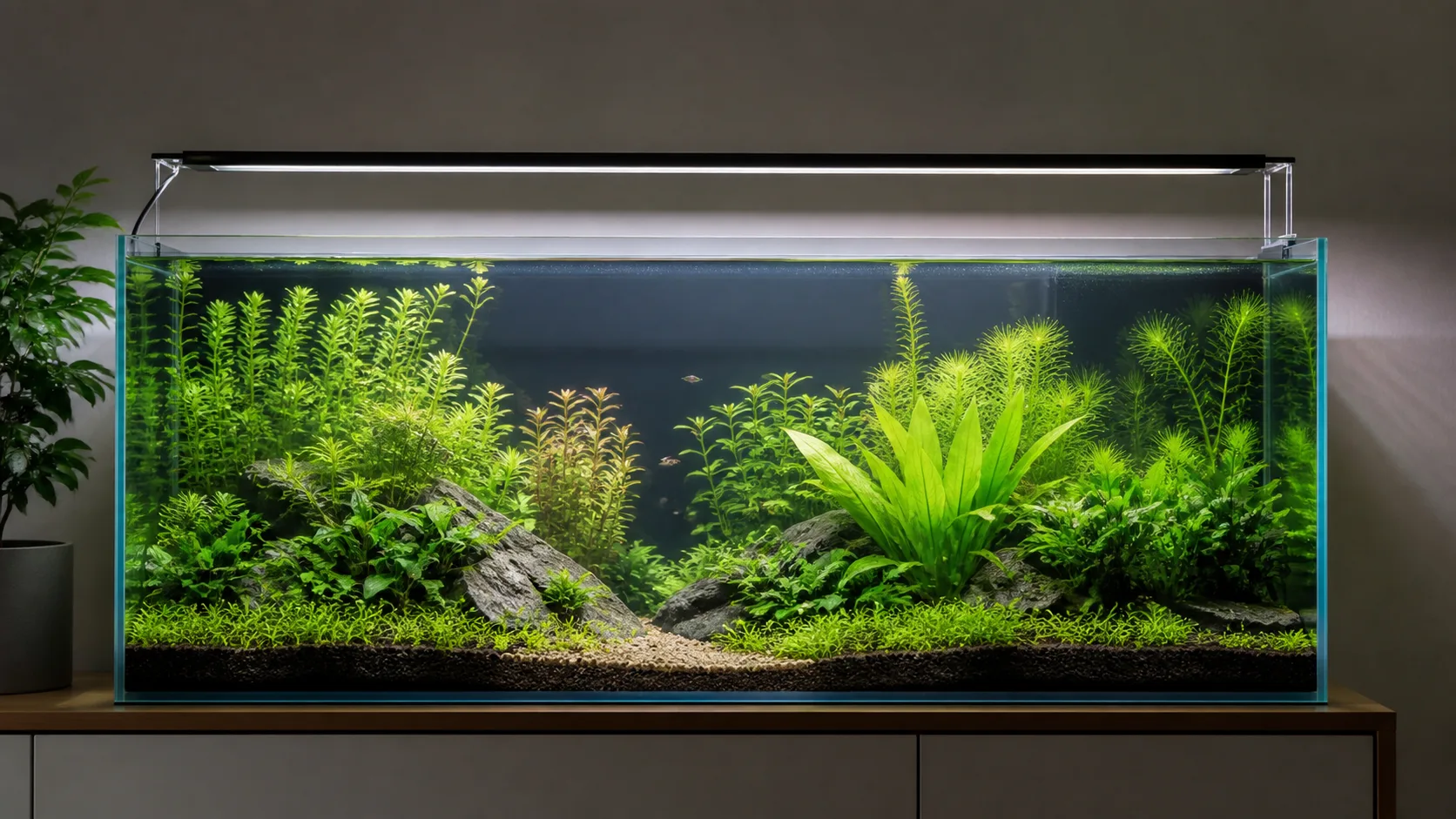
Lighting is the one piece of aquarium equipment people most often get wrong in both directions — too weak for the plants they want, or so strong it triggers an algae problem they spend months fighting. Getting the light right from the start makes a planted tank dramatically easier to keep.
Table of Contents
- What Light Actually Does in a Planted Tank
- Low Light vs High Light: The Only Distinction That Matters
- Choosing a Fixture
- Spectrum and Colour: What to Look For
- Photoperiod: How Long to Run Your Light
- The Light–CO2–Nutrient Balance
- Signs Your Light Is Too Strong or Too Weak
- Common Lighting Mistakes
- Frequently Asked Questions
What Light Actually Does in a Planted Tank
Light is the energy source for photosynthesis. Plants use it, along with CO2 and nutrients, to grow. The catch is that all three have to be in balance: if you give plants more light than they can use — because CO2 or nutrients are the limiting factor — the surplus energy doesn’t vanish. Algae, which is far less fussy about conditions, uses it instead.
This is why “just add more light” is such common bad advice. More light only helps if the plants can actually keep up with it. Below their limit, extra light does nothing useful and often does real harm.
Low Light vs High Light: The Only Distinction That Matters
You don’t need to measure PAR or memorise lumen charts to succeed. What matters is which of two broad categories your setup falls into.
Low-tech / low light
A modest fixture, run 6–8 hours a day, no CO2 injection. This supports a large and genuinely beautiful range of plants — Anubias, Java fern, Bucephalandra, Cryptocoryne, mosses, Vallisneria, many stem plants — and it’s the setup we recommend for almost every beginner. Growth is slower, which also means less pruning and less algae. Our low-tech plants guide covers the full list.
Recommended Products
- Waterproof LED Light Bar — a simple, sealed bar light that’s plenty for a low-tech planted tank and shrugs off splashes
- Quanlong QL-V6 Clip LED — a compact clip-on light for nano tanks and rimless setups where a bar won’t fit
High-tech / high light
A strong fixture combined with pressurised CO2 and a full fertiliser routine. This is what you need for a lawn of Monte Carlo, vivid red plants, or a competition-style aquascape that grows in fast. It’s more rewarding to look at and more work to run — the balance is tighter, and mistakes show up as algae within days. Only step up to this once you’re comfortable maintaining the basics.
Recommended Products
- Scaper’s Island WRGB LED Bar Set — a 4-bar WRGB system with the output and colour control for a demanding planted layout
- 12W RGB Aquarium Light — a mid-range RGB fixture for stepping up plant growth without going all the way to a pro rig
Choosing a Fixture
Beyond output, a few practical points decide whether a light works well for your tank:
- Coverage: the fixture should span most of the tank’s length. A small spotlight over a 90cm tank grows a bright patch in the middle and nothing at the ends.
- Mounting: bar lights sit on the rim or on legs; clip lights clamp to the back glass; both need to match your tank’s edge. Rimless tanks usually need legs or a hanging kit.
- Water resistance: a splash-proof or sealed unit lasts far longer above an open-top tank than a bare fixture.
- Dimming: a light you can dim lets you tune output to your plants and dial back if algae appears — much more useful than a simple on/off unit.
Spectrum and Colour: What to Look For
Plants photosynthesise across a broad range of the spectrum, so any decent full-spectrum white LED will grow them. Where colour matters most is appearance: a warm, high-CRI white makes greens look natural and fish colours pop, while RGB and WRGB fixtures let you push reds and blues to make red plants and certain fish look more vivid.
A common mistake is running a heavily blue-shifted “marine” light on a freshwater planted tank. It looks dramatic but makes plants and most community fish look washed-out and grey. Stick with a white-dominant spectrum for freshwater.
Photoperiod: How Long to Run Your Light
For most planted tanks, 6–8 hours a day is the sweet spot. Longer photoperiods don’t grow plants faster once their daily needs are met — they just give algae more hours to work with. A timer that switches the light on and off at the same times every day keeps the tank stable and takes the decision off your plate.
A “siesta” schedule — lights on for a few hours, off for a few, then on again — is popular and can help in some tanks, but it’s not essential. A simple single block on a timer works for the large majority of setups.
The Light–CO2–Nutrient Balance
Think of light as the throttle and CO2 plus nutrients as the fuel. The moment you turn the light up past what your fuel supports, plants stall and algae takes the excess. That’s why upgrading to a stronger light is rarely a standalone decision:
- Low light, no CO2, occasional liquid fertiliser — stable and easy.
- Higher light, CO2 injection, consistent daily fertiliser dosing — fast growth, tighter margins.
- Higher light, no CO2 — the worst of both: algae-prone and hard to correct.
Recommended Products
- All-in-One Plant Fertiliser — a single-bottle fertiliser that covers a low-to-mid light planted tank without a complex dosing schedule
- 6kg CO2 Cylinder Complete System — the CO2 side of the equation if you’re moving to a high-light setup
Our CO2 systems guide walks through whether you actually need injection, and our algae guide covers the fixes when the balance slips.
Signs Your Light Is Too Strong or Too Weak
You rarely need a meter to work out whether your lighting is off. The plants and the glass tell you.
Signs the light is too strong for your setup
- Green spot algae appearing quickly on the glass, especially the front pane.
- A fuzzy green or black beard algae taking hold on slower plants and hardscape edges.
- Fast-growing stems that look pale or yellowish at the top despite regular fertiliser — a sign they’re outrunning their nutrient or CO2 supply.
- Pearling (streams of oxygen bubbles) only in the first hour, then the tank looks stressed by mid-afternoon.
The fix is usually to dim the fixture, shorten the photoperiod, or — if you want to keep the light where it is — add CO2 and step up fertiliser dosing so the plants can actually use it.
Signs the light is too weak for your plants
- Lower leaves on stem plants yellowing and dropping while the tops keep growing toward the surface.
- Carpeting plants growing tall and leggy instead of spreading sideways.
- Red plants staying green.
- New growth that’s small, thin, and slow across weeks, not days.
Here the fix is either a stronger fixture or — often the smarter move — swapping the demanding plants for species that are genuinely happy in low light. A thriving low-light tank looks far better than a struggling high-light one.
Signs the balance is right
Healthy new growth in a natural colour, compact form on carpets, red plants showing at least some colour, and glass that only needs a wipe every week or two. Some algae on the hardscape is normal and nothing to chase — it’s total absence of plant growth or a sudden algae bloom that signals a real problem.
Common Lighting Mistakes
- Buying the brightest light available “to be safe,” then fighting algae for months.
- Running the light 10–12 hours a day because it looks nice in the evening.
- Pairing a high-output light with no CO2 and wondering why plants melt.
- Choosing a fixture that only covers half the tank’s length.
- Using a blue-heavy marine spectrum on a freshwater planted tank.
- Leaving the tank near a window, so it gets an uncontrolled second “light source” all day.
Frequently Asked Questions
How many hours a day should aquarium lights be on?
6–8 hours for most planted tanks, ideally on a timer for consistency. Longer photoperiods rarely help plants and usually encourage algae.
Do low-tech aquarium plants need a special light?
No. A modest full-spectrum LED is plenty for Anubias, Java fern, Cryptocoryne, mosses and similar plants. They don’t benefit from a high-output fixture and can actually do worse under one without CO2.
Can too much light cause algae?
Yes — this is the single most common cause of algae in an otherwise healthy tank. Light that exceeds what your plants can use (because CO2 or nutrients are limiting) gets used by algae instead.
What light colour is best for a freshwater planted tank?
A white-dominant, full-spectrum light. RGB or WRGB fixtures add control over reds and blues for appearance, but a plain warm white grows plants perfectly well. Avoid heavily blue “marine” spectrums.
Do I need CO2 if I buy a stronger light?
Usually, yes. A high-output light without CO2 is the most algae-prone combination there is. If you’re not ready for CO2, stay with a lower-output fixture — the plants will be healthier.
Will my plants survive if my light isn’t strong enough?
Low-demand plants will. High-demand plants (carpets, most reds) will grow leggy, lose lower leaves, or melt. Match the plant list to the light you have rather than forcing it.
Conclusion
The best aquarium light is the one that matches your plants and your willingness to dose CO2 and fertiliser — not the most powerful one on the shelf. For most people that means a modest full-spectrum fixture on a 6–8 hour timer, which grows a wide range of plants with very little algae trouble. Step up only when you’re ready to feed the extra light with everything it needs.
Browse our current lighting range to find a fixture sized for your tank, and pair it with the plants, fertiliser, and CO2 that suit the setup you actually want to run.
Recommended Products
Internal Link Map
- Waterproof LED Light Bar
- Quanlong QL-V6 Clip LED
- Scaper’s Island WRGB LED Bar Set
- All-in-One Plant Fertiliser
- 6kg CO2 Cylinder Complete System
- Best Low-Tech Aquarium Plants for Beginners
- CO2 Systems Explained: Do You Need One?
- Types of Aquarium Algae and How to Get Rid of Them