 Discus
 Cichlids
 Angelfish
 Plecos & Catfish
 Community & Nano Fish
 Shrimp, Snails & Invertebrates
 Low-Tech Plants
 Medium-Tech plants
 High-Tech Plants
 Live Corals


 Terrarium Kits & Jars
 Terrarium Plants & Moss
 Bioactive Clean-up Crew

 Smart Control Systems
 Lighting
 Filtration
 Heaters
 Chiller & Cooling Fans
 Thermometers
 Air Pumps
 Wavemaker
 Protein Skimmer

 CO2 Diffusers
 CO2 Accessories & Drop Checkers
 Liquid Carbon & CO2 Alternatives



 Soil & Substrate
 Driftwood & Rocks
 Caves & Clays
 Filter Media, Sponge & Replacement Parts
 Tubing & Connectors




Aquarium Filtration Guide: Choosing the Right Filter

Aquarium Filtration Guide: Choosing the Right Filter
Table of Contents
- What Aquarium Filtration Actually Does
- Sizing a Filter to Your Tank
- Hang-On-Back (HOB) Filters
- Internal Filters
- Canister Filters
- Sponge Filters
- Filter Maintenance Without Killing Your Cycle
- Common Beginner Mistakes
- Frequently Asked Questions
What Aquarium Filtration Actually Does
Every functional aquarium filter handles three distinct jobs, and understanding them makes comparing filter types far easier. Mechanical filtration physically traps floating debris — uneaten food, plant litter, fine particulate — using a sponge or filter floss the water passes through. Biological filtration is arguably the most important job: beneficial bacteria colonize the filter media and convert toxic ammonia (from fish waste) into nitrite, then into far less harmful nitrate, in what’s known as the nitrogen cycle. Chemical filtration, usually via activated carbon or a specialty resin, removes dissolved impurities, odors, or discoloration from the water, though it’s optional for most established tanks rather than a hard requirement.
A good filter for your tank isn’t necessarily the one with the most features — it’s the one that provides enough biological surface area and water turnover for your specific stocking level, without creating so much flow that it stresses fish that prefer calmer water.
Sizing a Filter to Your Tank
The most common sizing guideline is turnover rate: aim for a filter that can process the tank’s total water volume roughly 4 to 6 times per hour for a typical community tank, more for heavily stocked or messy fish, less for a delicate or low-flow species setup like bettas or shrimp. A 100-liter tank, for example, benefits from a filter rated around 400–600 liters per hour of flow, though the manufacturer’s flow rating is usually measured without media installed, so real-world flow is somewhat lower once the filter is running.
Hang-On-Back (HOB) Filters
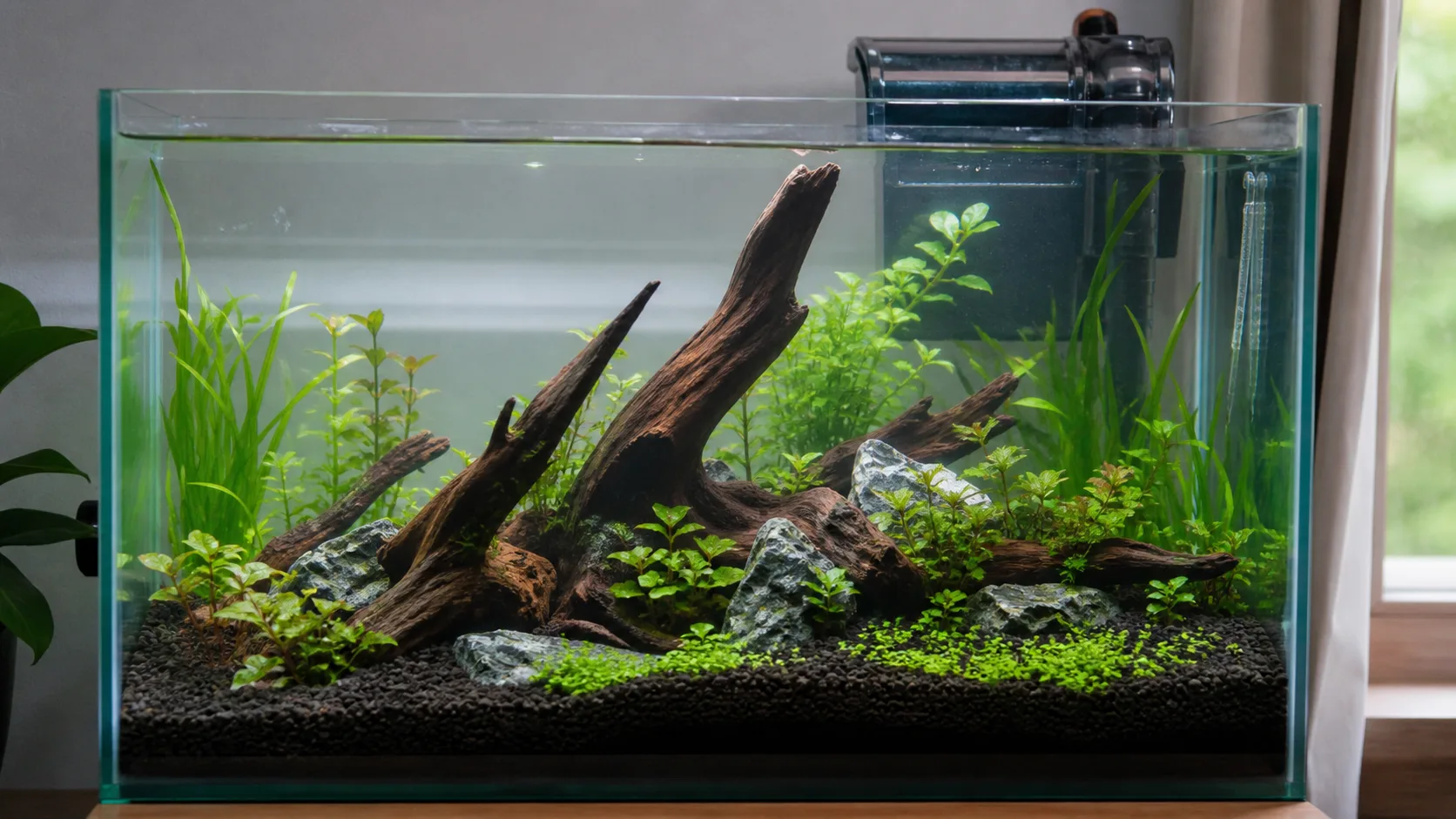
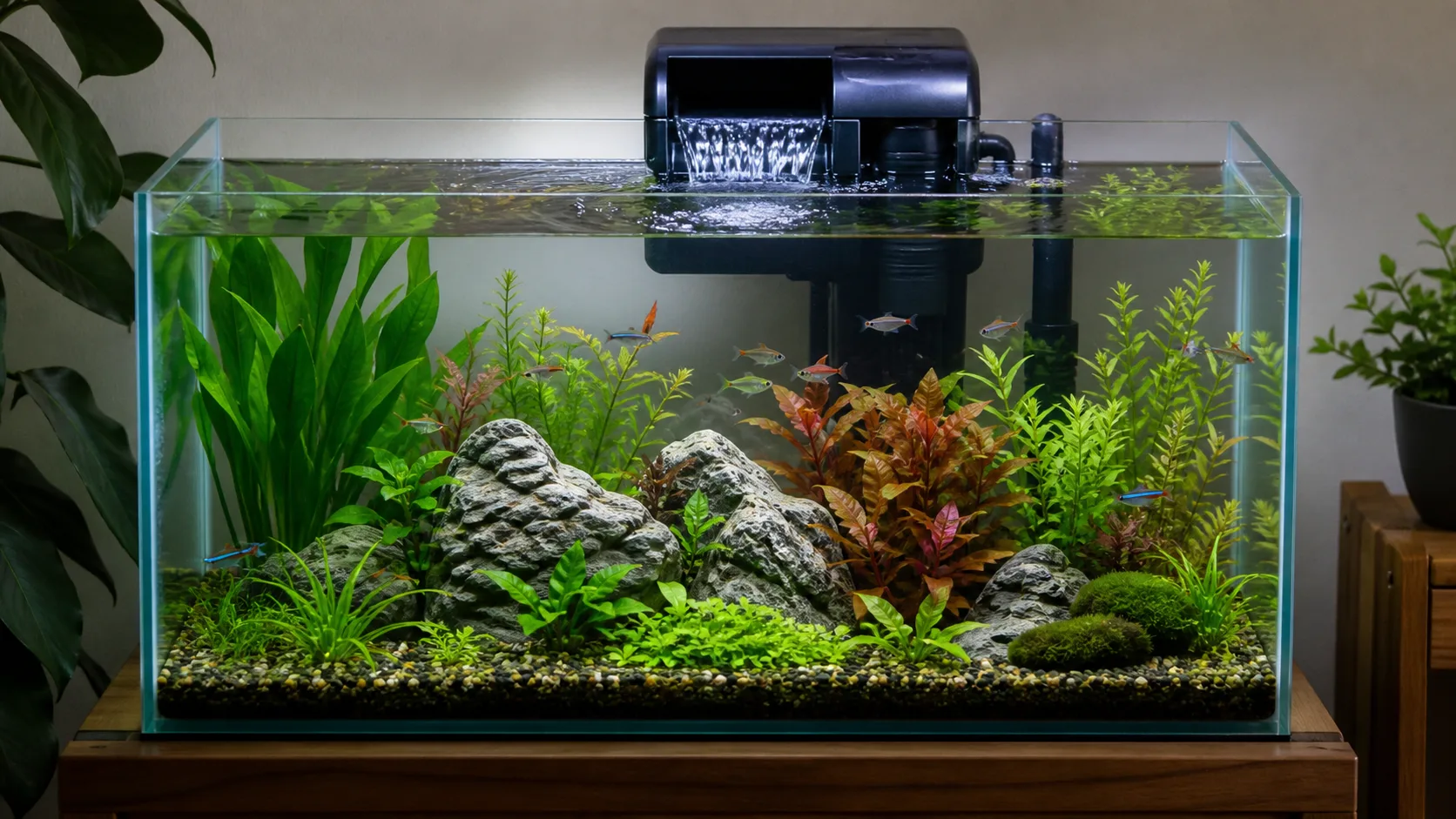
Hang-on-back filters hook onto the rear tank rim, drawing water up through an intake tube, pushing it through mechanical and biological media, and returning it to the tank as a waterfall-style outflow. They’re the most popular choice for beginner and intermediate freshwater tanks because they’re easy to install, easy to service without disturbing the tank much, and widely available at a range of price points and flow rates.
Recommended Products
- Xilong XL-300 Hang-On Filter — 300 L/H, budget-friendly for smaller tanks
- Hang-On-Back Filter 4W, 300 L/H — quiet operation, well suited to smaller and nano tanks
- Jeneca LT-600 Hang-On Filter — 500 L/H, a step up for medium tanks or heavier bioloads
- Sunsun HBL-803 Hang-On Filter — 500 L/H, 6W, rated for tanks up to 150 liters
Match flow rate to tank size using the turnover guideline above rather than defaulting to the cheapest or most powerful option: a 300 L/H filter is a reasonable fit for a small nano tank, while a 500 L/H model like the Jeneca LT-600 or Sunsun HBL-803 suits a medium tank or one with a heavier fish load. One tradeoff worth knowing: HOB filters create some surface agitation and a visible waterfall return, which is usually beneficial for oxygenation but can be too much current for slow-swimming or long-finned fish if the tank is small relative to the filter’s output.
Internal Filters
Internal filters sit entirely submerged inside the tank, drawing water through a sponge or cartridge with a small internal pump and returning it through a spray bar or directed outlet. They’re compact, inexpensive, and a solid choice for smaller tanks, quarantine setups, or as supplemental flow alongside a primary filter in a larger tank.
Recommended Product
- AquaSpeed A2001 BIO Internal Filter — 3W, compact biological filtration for smaller tanks
Because the entire unit sits inside the tank, an internal filter takes up some usable space and is somewhat more visible than a HOB or canister setup, which matters more in a heavily aquascaped tank where every visible object competes with the plants and hardscape for attention. In exchange, internal filters are simple to install with no external plumbing, and their flow direction is easy to adjust by angling the outlet, which makes them useful for creating current in a specific area of the tank rather than a single fixed return point.
Canister Filters
Canister filters sit outside the tank — typically in the cabinet below — and pull water down through inlet tubing, push it through multiple stacked media trays for mechanical, biological, and chemical filtration, then return it via outlet tubing, often to a spray bar for gentle, even flow. Because they hold significantly more media volume than a HOB or internal filter, canisters offer stronger biological capacity and are the standard choice for larger tanks, heavily stocked setups, or aquascapers who want maximum filtration without any visible equipment inside the tank.
The tradeoff is cost and complexity: canister filters are a bigger upfront investment, need proper tubing runs to and from the cabinet, and are more involved to service since you’re opening a sealed canister rather than lifting out a cartridge. We don’t currently have a canister filter in stock — check back, or start with a well-sized HOB filter and consider a canister as an upgrade if your tank size or stocking level grows beyond what a HOB can comfortably support.
Sponge Filters
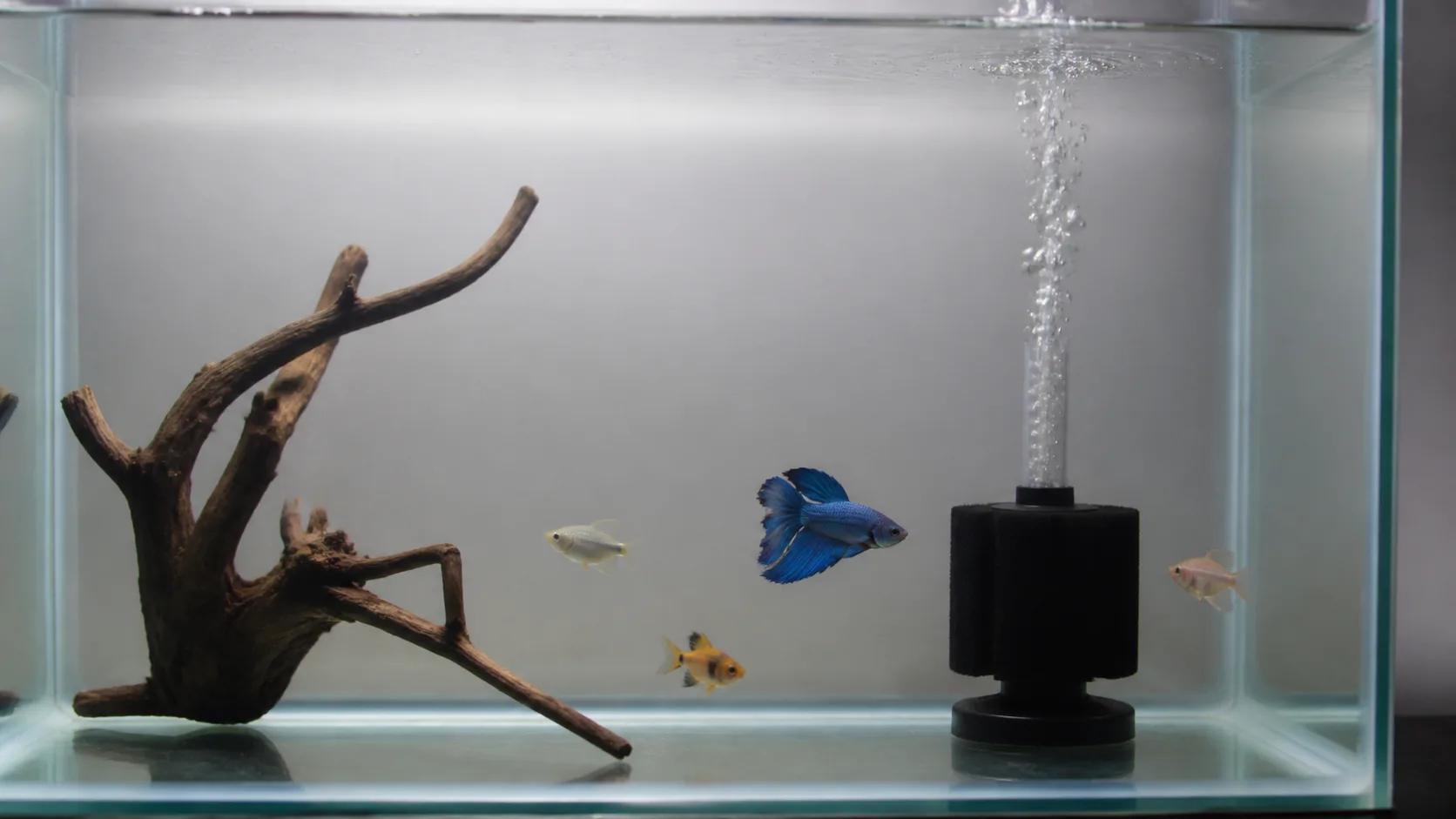
A sponge filter is about as simple as filtration gets: an air pump drives water through a submerged sponge via an airlift tube, providing gentle mechanical and biological filtration with virtually no risk of pulling in small fish, shrimp, or fry. That gentleness is exactly why sponge filters are the standard choice for shrimp tanks, fry-rearing tanks, and quarantine setups, where a stronger filter’s intake could injure small or delicate tank inhabitants.
We don’t currently have a sponge filter in stock — if your tank calls for one (shrimp, fry, or a quarantine setup), check back on availability before your next restock rather than substituting a stronger filter that could put small or delicate stock at risk.
Filter Maintenance Without Killing Your Cycle
The single most damaging filter maintenance mistake is rinsing biological media under tap water. Tap water’s chlorine or chloramine kills the beneficial bacteria colony that took weeks to establish, effectively resetting your tank’s biological filtration and risking an ammonia spike. Instead, rinse sponges and biological media in water siphoned out of the tank during a routine water change — it’s already dechlorinated and at a similar temperature, so the bacteria colony survives the cleaning.
- Rinse biological media in tank water removed during a water change, never under the tap
- Clean mechanical media (floss, fine sponge) more often than biological media — it clogs faster
- Never clean every piece of filter media on the same day; stagger it to avoid wiping out your whole bacteria colony at once
- Replace chemical media (carbon, resin) on the manufacturer’s schedule — it stops working once saturated, even if it looks fine
- Check intake tubes and impellers periodically for debris buildup that reduces flow over time
Common Beginner Mistakes
- Undersizing the filter for the tank’s actual bioload, not just its volume
- Rinsing biological media under tap water and crashing the nitrogen cycle
- Choosing a filter based on price alone rather than matching turnover rate to the tank
- Running a high-flow filter on a small tank housing slow or long-finned fish
- Turning the filter off overnight or during travel, which starves the bacteria colony of oxygen and food
- Replacing all filter media at once instead of staggering replacement over time
Frequently Asked Questions
What’s the best filter type for a beginner?
A hang-on-back (HOB) filter sized to your tank’s volume is the easiest starting point — simple to install, easy to service, and widely available at a range of flow rates.
How do I know what flow rate I need?
Aim for the filter to turn over your tank’s total water volume roughly 4 to 6 times per hour for a typical community tank. A 100-liter tank generally needs a filter rated around 400–600 liters per hour.
Can I use two filters on one tank?
Yes, and it’s a common approach — an internal filter alongside a HOB filter, for example, adds both flow and biological capacity, and gives you a backup if one filter needs servicing.
Why did my tank’s ammonia spike after I cleaned the filter?
You likely rinsed biological media under tap water, killing the beneficial bacteria colony that processes ammonia. Always rinse biological media in water removed from the tank during a water change instead.
Are sponge filters good enough for a community tank?
Usually not on their own — they’re best suited to shrimp tanks, fry-rearing, and quarantine setups where gentleness matters more than raw flow. A busier community tank typically needs a HOB, internal, or canister filter for adequate turnover.
Is a canister filter worth the extra cost?
For larger tanks, heavily stocked setups, or aquascapes where you don’t want visible equipment inside the tank, yes. For a typical beginner tank, a well-sized HOB filter usually delivers similar results for less money and less complexity.
How often should I clean my filter?
Check mechanical media (floss, fine sponge) every one to two weeks since it clogs fastest. Biological media needs far less frequent attention — a light rinse in tank water roughly once a month is usually enough.
Conclusion
Choosing the right filter comes down to matching flow rate and biological capacity to your tank’s actual bioload, not chasing the most expensive or most powerful option available. For most beginner and intermediate freshwater tanks, a properly sized hang-on-back filter checks every box; internal filters suit smaller tanks or extra flow, while canister and sponge filters solve more specific needs once you know what your tank calls for.
If you’re setting up a new tank or upgrading your current filtration, explore MyTankScape’s current filter selection to find one sized correctly for your setup.
Recommended Products
Internal Link Map
- Xilong XL-300 Hang-On Filter
- Hang-On-Back Filter 4W, 300 L/H
- Jeneca LT-600 Hang-On Filter
- Sunsun HBL-803 Hang-On Filter
- AquaSpeed A2001 BIO Internal Filter
- How to Start Your First Freshwater Aquarium
- CO₂ Systems Explained: Do You Need One?