
 Smart Control Systems
 Lighting
 Filtration
 Heaters
 Chiller & Cooling Fans
 Thermometers
 Water Pumps
 Air Pumps
 Wavemaker

 Low-Tech Plants
 Medium-Tech plants
 High-Tech Plants
 CO2 Diffusers

 Soil & Substrate
 Driftwood & Rocks
 Caves & Clays
 Filter Media, Sponge & Replacement Parts
 Tubing & Connectors



Aquarium Plant Fertilizers Explained

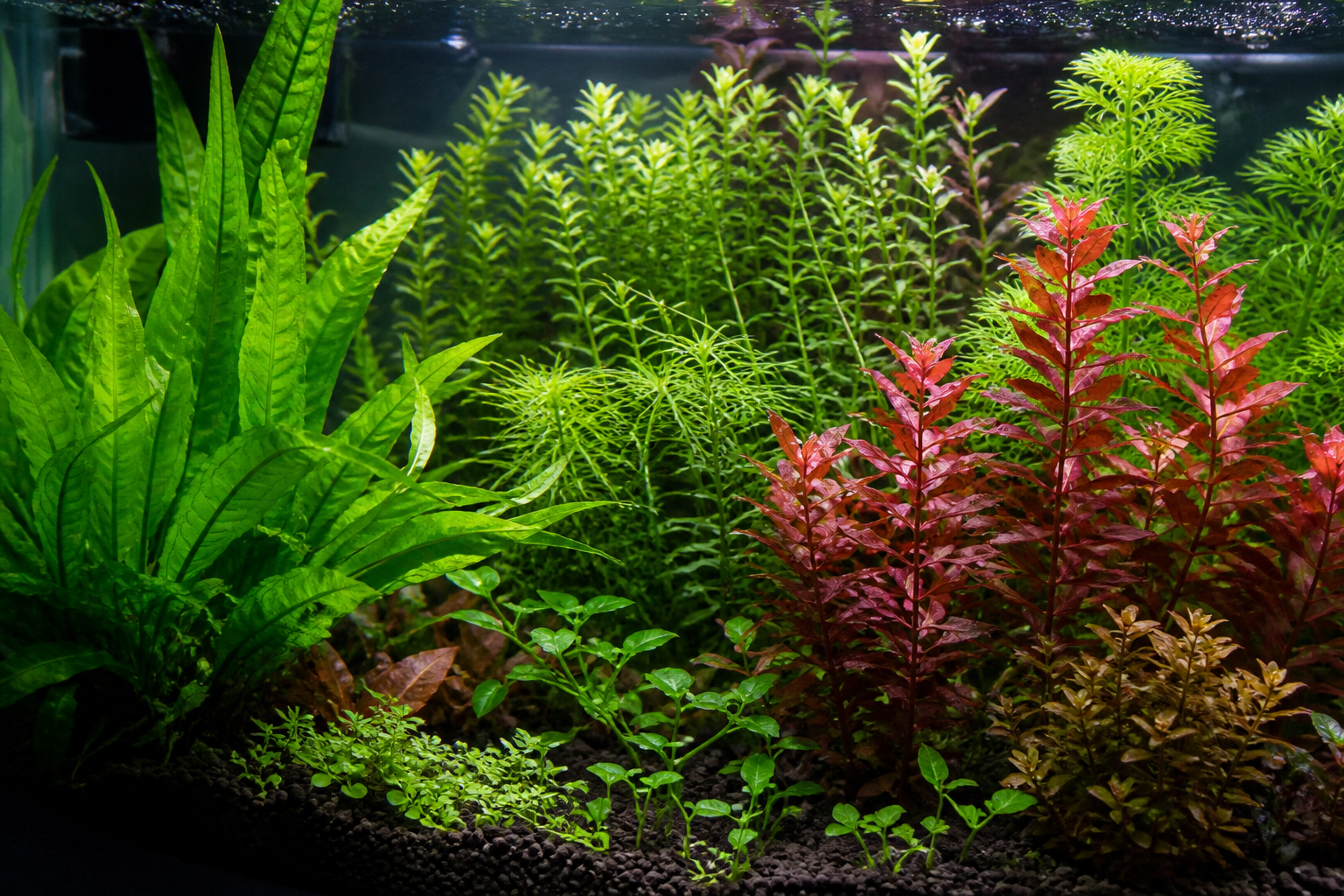
Quick answer: Aquarium plants need three fertilizer categories: macronutrients (nitrogen, phosphorus, potassium), micronutrients (iron and trace elements), and carbon (from CO₂ or a liquid carbon source). Root feeders like swords and crypts need root tabs in the substrate; stem plants and floating plants pull most of their nutrition straight from the water column via liquid fertilizer.
Plants that stall, yellow, or melt are almost always missing one of a small handful of things — and it’s rarely “the water is bad.” More often, it’s a specific nutrient deficiency that a targeted fertilizer fixes in days, not weeks. Understanding which nutrient does what turns fertilizing from guesswork into a routine.
Table of Contents
- The Three Things Plants Need
- Root Feeders vs. Water Column Feeders
- Reading Deficiency Symptoms
- A Simple Dosing Routine
- Common Fertilizing Mistakes
- FAQ
Aquarium Plant Fertilizers Explained
The Three Things Plants Need
- Macronutrients (NPK): nitrogen fuels leaf and stem growth, phosphorus supports root and energy transfer, potassium drives overall vigor and disease resistance. A deficiency in any of these shows up as slowed or stunted growth.
- Micronutrients (trace elements): iron is the big one — plants need it to produce chlorophyll, and an iron shortage is the single most common cause of yellowing new leaves.
- Carbon: plants build tissue from carbon, sourced either from injected CO₂ gas or a liquid carbon supplement. This is the input most low-tech tanks skip entirely, which caps growth even when NPK and iron are perfect.
Root Feeders vs. Water Column Feeders
Not every plant eats the same way, and fertilizing the wrong end wastes money and fixes nothing:
- Root feeders (Amazon swords, crypts, most Echinodorus) draw the bulk of their nutrition through their root system — a root tab pushed into the substrate near the roots feeds them directly where they actually absorb it.
- Water column feeders (stem plants like rotala and ludwigia, floating plants, mosses) absorb nutrients through their leaves — liquid fertilizer dosed into the water column is what actually reaches them; root tabs do little for a plant with no real root system.
- Many plants do both to some degree, which is why a combined routine (root tabs for heavy root feeders + regular liquid dosing for everything else) covers the widest range of a typical mixed planted tank.
Reading Deficiency Symptoms
- Yellowing new leaves, veins staying green: classic iron deficiency — dose a liquid iron supplement.
- Yellowing old leaves, new growth fine: often nitrogen deficiency — the plant is pulling nitrogen from older leaves to feed new growth.
- Holes or translucent patches in leaves: usually potassium deficiency.
- Stunted new growth, twisted leaf tips: often a micronutrient/calcium issue rather than a macronutrient one.
- Slow growth across the board despite dosing NPK and iron: almost always a missing carbon source — this is where a liquid carbon supplement earns its keep in a low-tech tank.
Tip: Change one variable at a time. Dosing five different fertilizers simultaneously after a problem appears makes it impossible to tell which one actually fixed it — and some combinations (excess phosphate, for instance) can trigger algae instead of solving the original issue.
A Simple Dosing Routine
- Root tabs: push one tab into the substrate near each heavy root feeder every 1–2 months.
- Liquid macro + micro fertilizer: dose 2–3 times weekly per the product’s instructions, ideally right after a water change so you’re dosing into freshly diluted water.
- Liquid carbon: dose daily in a low-tech tank without CO₂ injection — this single addition is often the difference between plants that survive and plants that actually grow.
- Watch, don’t guess: give any change 1–2 weeks before adjusting again; plant response is gradual, not immediate.
Recommended: The GreenTank Macro Fertilizer and GreenTank Micro Fertilizer cover the core NPK and trace-element routine, with GreenTank Iron and GreenTank Potassium for targeted top-ups when you spot a specific deficiency. For root feeders, push in Root Tabs near the base every 1–2 months. For a low-tech tank without CO₂, Carbo+ Liquid Carbon supplies the missing carbon input and helps control algae at the same time. The All-in-One Red Fertilizer is a convenient single-bottle option if you’d rather not juggle four separate products.
Common Fertilizing Mistakes
- Only using root tabs in a tank full of stem plants that can’t reach them — wasted product and no visible improvement.
- Skipping carbon entirely in a low-tech tank, then blaming “bad genetics” or lighting for slow growth.
- Overdosing macros assuming more is always better — excess nutrients (especially phosphate and nitrate) commonly trigger algae blooms rather than better plant growth.
- Dosing right before a water change instead of after — you’re diluting away the fertilizer you just added.
- Giving up after a few days — plant response to a corrected deficiency typically takes 1–2 weeks to show visibly.
Frequently Asked Questions
Do I need CO₂ to fertilize plants?
No — a liquid carbon supplement provides a usable carbon source for low-tech tanks without pressurized CO₂, just at a slower growth rate than a true high-tech setup.
No — a liquid carbon supplement provides a usable carbon source for low-tech tanks without pressurized CO₂, just at a slower growth rate than a true high-tech setup.
How often should I dose liquid fertilizer?
2–3 times weekly for macro/micro nutrients is a reasonable starting routine; adjust based on how plants respond over the following weeks.
2–3 times weekly for macro/micro nutrients is a reasonable starting routine; adjust based on how plants respond over the following weeks.
Can too much fertilizer cause algae?
Yes — excess nitrate and especially phosphate are common algae triggers, which is why dosing to the label’s recommendation (not more) matters.
Yes — excess nitrate and especially phosphate are common algae triggers, which is why dosing to the label’s recommendation (not more) matters.
Do all plants need root tabs?
No — only true root feeders like swords and crypts benefit meaningfully; stem plants and floating plants get little from a tab buried in the substrate.
No — only true root feeders like swords and crypts benefit meaningfully; stem plants and floating plants get little from a tab buried in the substrate.
Why are my plant’s new leaves yellow but old leaves green?
That pattern points to iron deficiency, since iron isn’t mobile within the plant the way nitrogen is — dose a liquid iron supplement and expect improvement within 1–2 weeks.
That pattern points to iron deficiency, since iron isn’t mobile within the plant the way nitrogen is — dose a liquid iron supplement and expect improvement within 1–2 weeks.
Is liquid fertilizer safe for fish and shrimp?
Yes, when dosed at the recommended rate — aquarium plant fertilizers are formulated for tanks with livestock, not for pond or hydroponic use.
Yes, when dosed at the recommended rate — aquarium plant fertilizers are formulated for tanks with livestock, not for pond or hydroponic use.
Conclusion
Match the fertilizer to how the plant actually feeds — root tabs for root feeders, liquid dosing for everything else — add a carbon source if you’re running low-tech, and read deficiency symptoms before reaching for more product. Most “my plants won’t grow” problems trace back to one missing input, not a mysterious water issue.
Recommended Products
- GreenTank Macro Fertilizer
- GreenTank Micro Fertilizer
- GreenTank Iron
- Carbo+ Liquid Carbon
- All-in-One Red Fertilizer