 Discus
 Cichlids
 Angelfish
 Plecos & Catfish
 Community & Nano Fish
 Shrimp, Snails & Invertebrates
 Low-Tech Plants
 Medium-Tech plants
 High-Tech Plants
 Live Corals


 Terrarium Kits & Jars
 Terrarium Plants & Moss
 Bioactive Clean-up Crew


 Smart Control Systems
 Lighting
 Filtration
 Heaters
 Chiller & Cooling Fans
 Thermometers
 Air Pumps
 Wavemaker
 Protein Skimmer
 CO2 Diffusers
 CO2 Accessories & Drop Checkers
 Liquid Carbon & CO2 Alternatives


 Soil & Substrate
 Driftwood & Rocks
 Caves & Clays
 Filter Media, Sponge & Replacement Parts
 Tubing & Connectors



Water Parameters 101: Testing pH, Ammonia, Nitrite, and Nitrate

Water Parameters 101: Testing pH, Ammonia, Nitrite, and Nitrate
Table of Contents
- Why Water Testing Matters More Than It Seems
- Ammonia: The Only Safe Reading Is Zero
- Nitrite: Just as Dangerous, Easy to Miss
- Nitrate: The End of the Cycle
- pH: Stability Matters More Than the Number
- TDS and General Hardness
- How Often to Actually Test
- What to Do When a Reading Is Off
- Common Testing Mistakes
- Frequently Asked Questions
Why Water Testing Matters More Than It Seems
Most fish health problems don’t start as diseases — they start as water quality problems that stress a fish until something opportunistic (a parasite, a bacterial infection) takes hold. Testing catches a developing problem while it’s still an easy fix — a water change — rather than after it’s already become a health crisis with visible symptoms and a much narrower set of solutions.
The four core numbers to track in a freshwater tank are ammonia, nitrite, nitrate, and pH. Together they tell you whether your tank’s biological filtration (the nitrogen cycle) is functioning correctly, and whether your water chemistry actually matches what your fish and plants need — information you simply can’t get by looking at the tank, since a fish can look completely normal while swimming in water that’s quietly poisoning it.
Recommended Products
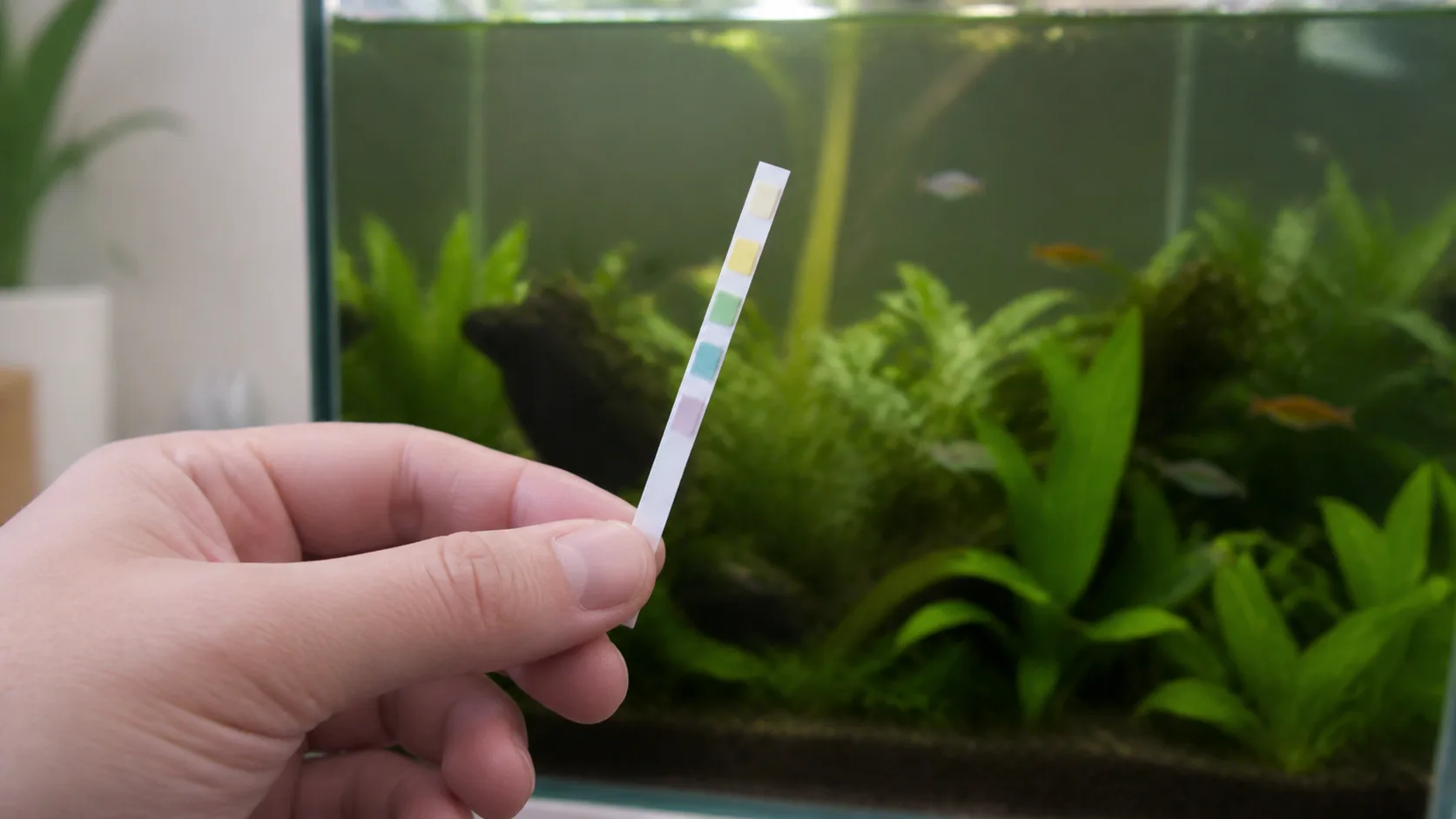
- API 5-in-1 Aquarium Test Strips (25 ct) — a fast way to check ammonia, nitrite, nitrate, pH, and hardness in one dip
- Digital pH Meter (0–14 range) — more precise, repeatable pH readings than color-matching strips
Ammonia: The Only Safe Reading Is Zero
Ammonia comes from fish waste, uneaten food, and decaying organic matter, and it’s directly toxic to fish even at low concentrations — there’s no “acceptable trace amount” the way there is with nitrate. In a newly set-up, uncycled tank, ammonia is the first thing to spike, since the beneficial bacteria that process it haven’t established yet.
Any detectable ammonia in an established, fully cycled tank points to a real problem — overfeeding, overstocking, a filter that’s lost its bacteria colony (often from rinsing media under tap water), or a tank that was never fully cycled in the first place. A water change is the fastest way to bring the level down while you investigate and fix the underlying cause.
Nitrite: Just as Dangerous, Easy to Miss
Nitrite is what ammonia converts into as the nitrogen cycle progresses, and it’s arguably just as dangerous as ammonia despite getting less attention — it interferes with a fish’s ability to carry oxygen in its bloodstream, which can cause fish to gasp at the surface even though the tank has plenty of dissolved oxygen. Like ammonia, the only genuinely safe reading is zero.
Nitrite typically spikes in the middle of a new tank’s cycling process, after ammonia has started dropping but before the second group of beneficial bacteria (which converts nitrite into nitrate) has fully established. This is exactly why testing throughout the entire cycling process matters, not just checking once at the start and assuming things are fine.
Nitrate: The End of the Cycle
Nitrate is the final product of the nitrogen cycle and is far less immediately toxic than ammonia or nitrite, which is why a small amount is considered normal in an established tank rather than a sign of a problem. That said, “low is best” — most keepers aim to keep nitrate under roughly 20–40 ppm through regular water changes, since chronically high nitrate does still stress fish and encourage algae growth over time.
pH: Stability Matters More Than the Number
pH measures how acidic or alkaline your water is, and while most community freshwater fish tolerate a pH somewhere between 6.5 and 7.5, the specific number matters less than how stable it stays over time. A sudden pH swing — even within a range that would be fine if reached gradually — is far more stressful to fish than a slightly “wrong” but stable number.
Different species genuinely need different pH ranges — soft, acidic water for Discus versus hard, alkaline water for many African cichlids, for example — which is exactly why matching a species’ actual water chemistry needs, not just its temperature and tank size, matters before you buy it.
TDS and General Hardness
Recommended Product
- Digital TDS Meter — measures total dissolved solids and water temperature in one reading
TDS (total dissolved solids) measures the overall mineral content of your water, which relates closely to general hardness (GH). It’s especially useful when keeping species with specific hardness needs — soft water for many South American species, hard water for African rift lake cichlids — or when troubleshooting why a species that should be thriving isn’t, even though ammonia, nitrite, and nitrate all read normal.
How Often to Actually Test
During the first four to six weeks of a new tank (the cycling period), test daily — this is when ammonia and nitrite swings happen fastest and matter most, and daily testing is what actually lets you catch and respond to a spike before it harms fish. Once a tank is established and stable, weekly testing is generally enough to catch a developing problem early.
Test immediately, regardless of your normal schedule, whenever you notice unusual fish behavior (gasping, lethargy, loss of appetite), after adding new fish, after a significant water change or filter cleaning, or after any equipment failure (a filter or heater that stopped working) — these are exactly the situations where parameters are most likely to have shifted unexpectedly.
What to Do When a Reading Is Off
A water change is the correct first response to almost any bad reading — it directly dilutes ammonia, nitrite, and nitrate, and it’s the fastest way to buy time while you investigate the underlying cause (overfeeding, overstocking, a failing filter, an uncycled tank). Always treat new water with a dechlorinator before it touches the tank, since tap water’s chlorine or chloramine is harmful to fish and will also kill beneficial filter bacteria on contact.
Recommended Product
- Seachem Safe Water Conditioner — neutralizes chlorine and chloramine before new water reaches your fish
If a bad reading persists after a water change, look for the underlying cause rather than just repeating water changes indefinitely: check your feeding amount, confirm your filter’s biological media hasn’t been rinsed under tap water recently, and verify your tank is actually fully cycled if it’s still relatively new.
Common Testing Mistakes
- Only testing when a fish already looks sick, instead of on a regular schedule
- Skipping daily testing during the first few weeks of a new, uncycled tank
- Using expired test strips or reagents, which give inaccurate readings
- Reading color-based tests under poor or inconsistent lighting
- Repeating water changes without ever identifying why a reading keeps coming back bad
- Ignoring pH entirely because “it’s usually fine,” missing a slow drift that eventually stresses fish
Frequently Asked Questions
What’s the ideal ammonia level in a fish tank?
Zero. There’s no genuinely safe non-zero ammonia reading in an established tank — any detectable amount points to a real problem worth investigating.
Is a pH of 7.8 bad for my fish?
Not necessarily — it depends on the species and, more importantly, on stability. Many fish tolerate a range of pH values fine as long as it stays consistent; a sudden swing is more dangerous than a stable “imperfect” number.
How often should I test water in an established tank?
Weekly is generally enough once a tank is stable and fully cycled. Test immediately (regardless of schedule) if you notice unusual fish behavior, after adding new fish, or after any equipment failure.
Why does my nitrate keep climbing?
Nitrate accumulates between water changes as part of the normal nitrogen cycle. Steadily climbing nitrate usually means your water change frequency or volume needs to increase relative to your current stocking and feeding.
Are test strips accurate enough, or do I need liquid tests?
Test strips are convenient and reasonably accurate for routine monitoring. A digital meter (like a pH or TDS meter) gives more precise, repeatable numbers, which matters more for species with narrow parameter tolerances.
My ammonia and nitrite are both zero but my fish still seem stressed. What else should I check?
Check nitrate, pH stability, TDS/hardness, and temperature — a fish can be stressed by a parameter mismatch (wrong hardness for the species, for example) even when the core nitrogen-cycle numbers look perfect.
Conclusion
Ammonia, nitrite, nitrate, and pH are the four numbers that tell you what’s actually happening in your tank’s water, often well before a fish shows any visible symptoms. Test daily during a new tank’s cycling period, weekly once established, and immediately whenever something seems off — and always investigate the underlying cause of a bad reading rather than just repeating water changes without knowing why.
If you’re setting up water testing for the first time, explore MyTankScape’s current test kits and water conditioners to build a simple, reliable testing routine.
Recommended Products
Internal Link Map
- API 5-in-1 Aquarium Test Strips (25 ct)
- Digital pH Meter (0–14 range)
- Digital TDS Meter
- Seachem Safe Water Conditioner
- Common Freshwater Fish Diseases and How to Treat Them
- How to Start Your First Freshwater Aquarium
- Fish Compatibility Guide: Which Fish Can Live Together