 Discus
 Cichlids
 Angelfish
 Plecos & Catfish
 Community & Nano Fish
 Shrimp, Snails & Invertebrates

 Low-Tech Plants
 Medium-Tech plants
 High-Tech Plants
 Live Corals


 Terrarium Kits & Jars
 Terrarium Plants & Moss
 Bioactive Clean-up Crew


 Smart Control Systems
 Lighting
 Filtration
 Heaters
 Chiller & Cooling Fans
 Thermometers
 Air Pumps
 Wavemaker
 Protein Skimmer

 CO2 Diffusers
 CO2 Accessories & Drop Checkers
 Liquid Carbon & CO2 Alternatives





 Soil & Substrate
 Driftwood & Rocks
 Caves & Clays

 Filter Media, Sponge & Replacement Parts
 Tubing & Connectors






African Cichlid Tank Setup: Water Parameters and Stocking Guide

African Cichlid Tank Setup: Water Parameters and Stocking Guide
Table of Contents
- Why African Cichlids Need a Different Approach
- Water Parameters: Hard and Alkaline
- Tank Setup: Rockwork Over Plants
- Mbuna vs. Peacock: Two Different Temperaments
- Stocking to Spread Out Aggression
- Introducing New Fish to an Established Tank
- Diet
- Common Beginner Mistakes
- Frequently Asked Questions
Why African Cichlids Need a Different Approach
Most freshwater setup advice assumes soft-to-moderate water and calmer, community-style stocking — African rift lake cichlids need the opposite of both. They come from Lake Malawi’s clear, mineral-rich, alkaline water, and their social structure is built around defended rock territories rather than peaceful shoaling, which means both your water chemistry and your stocking plan need to work differently from a typical community tank from day one.
The reward for getting this right is genuinely spectacular: African cichlids are some of the most vividly colored freshwater fish available, with complex social behavior that’s fascinating to watch once a tank is properly established.
Water Parameters: Hard and Alkaline
Target a pH between roughly 7.8 and 8.6, with hard, alkaline water — a stark contrast to the soft, acidic water many other popular freshwater species (Discus, for example) actually need. Keep temperature in the 24–28°C range, with most species doing well around the middle of that band.
Because African cichlids are messier, more heavily stocked fish than a typical community tank, strong filtration and regular water changes matter more here than in a lightly-stocked setup — our filtration guide covers sizing a filter to a heavier bioload, and our water parameters guide covers testing routines to catch problems before they show up as stressed fish.
Tank Setup: Rockwork Over Plants
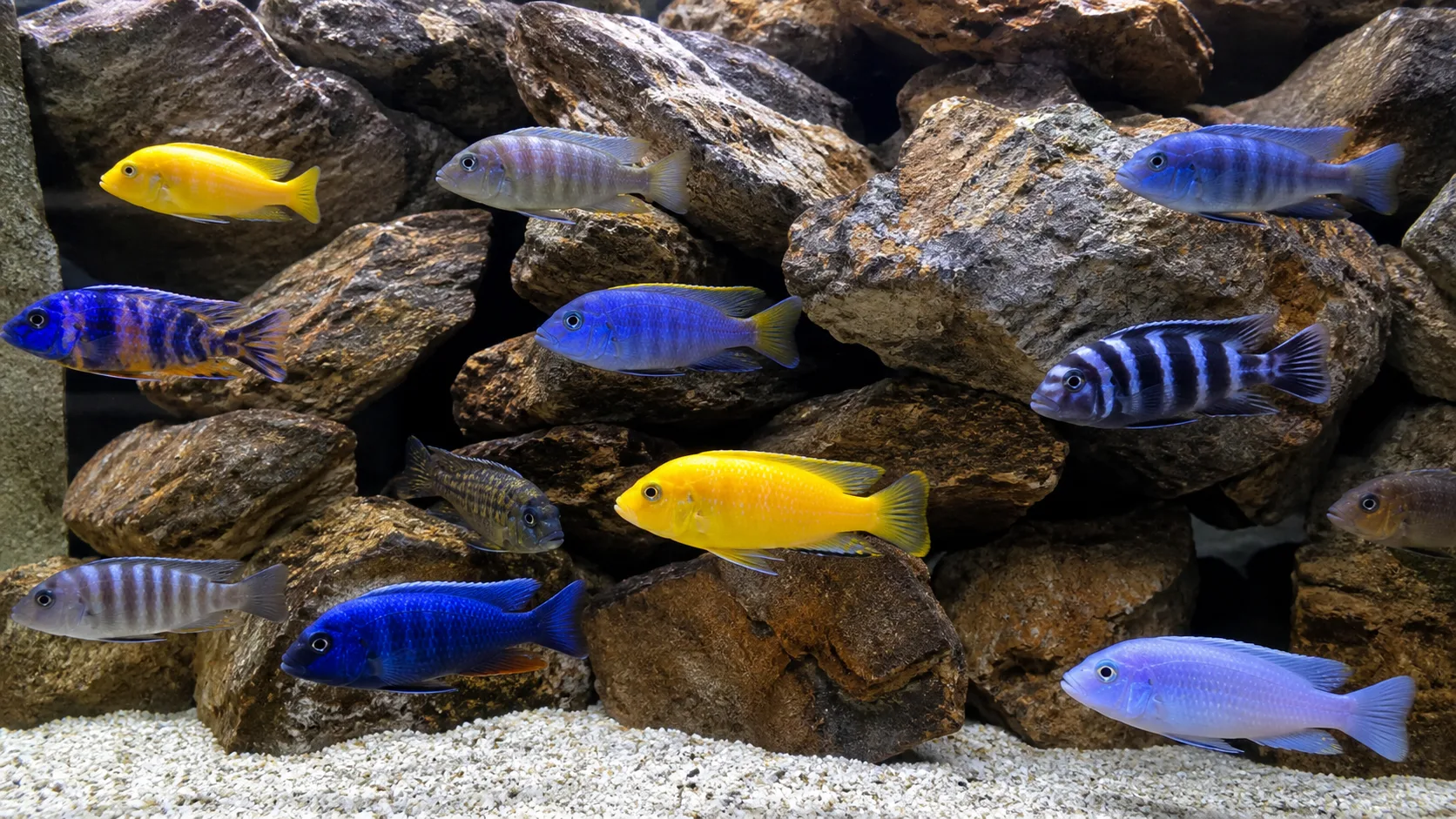
Rockwork is the centerpiece of a Malawi-style tank, not an accent — stack rock into caves, crevices, and defendable territories, since this structure is what lets multiple cichlids coexist by giving each fish (or breeding pair) a spot to claim and defend rather than competing over open space. Live plants are generally impractical since most African cichlids will uproot or eat them; if you want green in the tank, hardy, rock-anchored options or artificial plants are the more realistic choice.
Recommended Product
- 60×60×60cm Aquarium with Sump and Wooden Stand — a spacious footprint suited to building out real rockwork and hosting a proper-sized group
Use enough rock that territories overlap less — sparse rockwork concentrates competition over the few good spots available, while dense rockwork with many caves and crevices spreads fish out and genuinely reduces overall aggression in the tank.
Mbuna vs. Peacock: Two Different Temperaments
Mbuna are the more aggressive, algae-grazing rock-dwellers of Lake Malawi, and species like Demasoni are known for being aggressive even by mbuna standards — they genuinely need larger groups and careful stocking ratios to keep that aggression from concentrating on one individual.
Recommended Products
- Demasoni African Cichlid — small but intensely territorial mbuna, needs a proper group size
- OB Aulonocara African Cichlid — a calmer peacock variety with striking patterning
Peacocks (Aulonocara) are generally calmer, more open-water-oriented, and known for exceptionally vivid coloration, making them a popular way to soften the overall temperament of a predominantly mbuna tank — though mixing the two groups still needs planning, since even “calm” peacocks can be bullied by an overly aggressive mbuna population.
Recommended Products
Stocking to Spread Out Aggression
The core stocking principle in a Malawi tank is counterintuitive at first: overstocking slightly, not understocking, is what actually keeps aggression manageable. A tank with too few cichlids concentrates territorial disputes onto whichever fish ranks lowest in the pecking order, while a properly sized, denser group spreads that same aggression thin enough that no single fish takes the brunt of it.
A widely used ratio for mbuna is roughly one male to several females per species, and stocking multiple species together (rather than just multiples of one) also helps, since inter-species aggression tends to be somewhat less intense than aggression between males of the exact same species competing for the same mates and territory.
Introducing New Fish to an Established Tank
Adding new cichlids to an already-established, territorial tank is riskier than stocking a brand-new setup, since existing fish have already claimed the best rock territories and treat any newcomer as an intruder rather than a peer. Rearranging the rockwork slightly when you add new fish helps reset territorial boundaries for everyone, temporarily leveling the playing field instead of dropping newcomers into a tank where every good spot is already spoken for.
Adding several new fish at once, rather than a single individual, also spreads the established residents’ attention across multiple targets instead of concentrating it on one newcomer — the same underlying logic as overstocking a new tank from the start. Watch closely for the first few days after any addition, since this is when aggression toward a new fish is most likely to escalate into a real problem rather than settling into normal pecking-order behavior.
Diet
Most mbuna are primarily herbivorous algae-grazers in the wild and do best on a vegetable-based cichlid pellet, since a diet too heavy in protein can contribute to bloat and digestive issues in these species specifically. Peacocks and more predatory species like Livingstone’s tolerate more protein in their diet, which is exactly why researching your specific species mix — rather than feeding one generic cichlid food to the whole tank — genuinely matters here.
Common Beginner Mistakes
- Keeping soft or neutral water instead of the hard, alkaline chemistry Malawi cichlids actually need
- Understocking, which concentrates aggression on one fish instead of spreading it out
- Adding live plants that get immediately uprooted or eaten
- Not providing enough rockwork and caves for every fish to claim a territory
- Feeding a protein-heavy diet to primarily herbivorous mbuna species
- Assuming all “African cichlids” behave the same way instead of researching each species
Frequently Asked Questions
What pH do African cichlids need?
Roughly 7.8 to 8.6 — hard, alkaline water that’s the opposite of what many other popular freshwater species need. Consistency matters as much as hitting the exact number.
Can I mix mbuna and peacocks in the same tank?
Yes, with planning — peacocks are generally calmer, so balance the ratio carefully and provide enough rockwork and territory that peacocks aren’t overwhelmed by more aggressive mbuna tankmates.
Why does overstocking actually help with aggression?
A tank with too few cichlids concentrates territorial aggression onto the lowest-ranking individual. A properly sized, denser group spreads that aggression across many fish instead of focusing it on one.
Can I keep live plants in an African cichlid tank?
Generally not successfully — most African cichlids uproot or eat live plants. Rock-anchored hardy options or artificial plants are the more realistic choice.
What should I feed my African cichlids?
It depends on the species — primarily herbivorous mbuna do best on a vegetable-based cichlid pellet, while peacocks and more predatory species like Livingstone’s tolerate more protein. Research your specific mix rather than using one generic food.
How big a tank do I need for a Malawi cichlid setup?
A large footprint matters more than height, since these fish need territory along the tank floor and rockwork. A generously sized tank gives you room for a proper group and enough rock structure to spread out aggression.
Conclusion
African rift lake cichlids reward a setup built specifically around them — hard, alkaline water, dense rockwork instead of plants, and a stocking approach where a properly sized, mixed group actually reduces aggression rather than increasing it. Get the water chemistry and rockwork right, research each species you’re mixing rather than treating “African cichlid” as one behavior, and you’ll get one of the most visually spectacular freshwater setups in the hobby.
If you’re planning a Malawi-style tank, explore MyTankScape’s current African cichlid selection to build a group that matches your tank size and stocking plan.
Recommended Products
Internal Link Map
- Demasoni African Cichlid
- OB Aulonocara African Cichlid
- Yellow Sunshine Peacock
- Eureka Red Peacock
- Livingstone’s African Cichlid
- 60×60×60cm Aquarium with Sump and Wooden Stand
- Aquarium Filtration Guide: Choosing the Right Filter
- Water Parameters 101: Testing pH, Ammonia, Nitrite, and Nitrate
- Fish Compatibility Guide: Which Fish Can Live Together