 Discus
 Cichlids
 Angelfish
 Plecos & Catfish
 Community & Nano Fish
 Shrimp, Snails & Invertebrates

 Low-Tech Plants
 Medium-Tech plants
 High-Tech Plants
 Live Corals

 Terrarium Kits & Jars
 Terrarium Plants & Moss
 Bioactive Clean-up Crew


 Smart Control Systems
 Lighting
 Filtration
 Heaters
 Chiller & Cooling Fans
 Thermometers
 Air Pumps
 Wavemaker
 Protein Skimmer

 CO2 Diffusers
 CO2 Accessories & Drop Checkers
 Liquid Carbon & CO2 Alternatives





 Soil & Substrate
 Driftwood & Rocks
 Caves & Clays

 Filter Media, Sponge & Replacement Parts
 Tubing & Connectors






Types of Aquarium Algae and How to Get Rid of Them

Types of Aquarium Algae and How to Get Rid of Them
Table of Contents
- Why Algae Shows Up in the First Place
- Green Hair Algae
- Brown Diatom Algae
- Black Beard/Brush Algae
- Green Water (Algae Bloom)
- Blue-Green Algae (Cyanobacteria)
- Biological Control: Real Algae-Eaters
- Healthy Plants Are Your Best Long-Term Defense
- Prevention
- Common Mistakes
- Frequently Asked Questions
Why Algae Shows Up in the First Place
Algae isn’t a sign of a dirty tank so much as a sign of imbalance — too much light relative to how fast your plants can use it, too many available nutrients (from overfeeding, overstocking, or excess fertilizer), or unstable CO2 that lets plants stall out while algae, which is less picky, keeps growing. Identifying the specific type of algae you’re seeing is genuinely useful, since different types point to different underlying causes.
Green Hair Algae
Green hair algae grows as long, stringy strands attached to plants, decorations, and equipment, and is one of the most common types beginners encounter. It typically points to excess light combined with excess nutrients — a classic combination in a tank running a long photoperiod with heavy feeding or fertilizing relative to how much the plants are actually using.
Manual removal is the fastest first step: twirl strands out with a toothbrush or your fingers, which physically removes a large share of the problem immediately rather than waiting for a fix to work over weeks. Reducing photoperiod and nutrient input addresses the underlying cause so it doesn’t simply return.
Brown Diatom Algae
Brown, dusty-looking algae on glass and decorations is extremely common in new tanks during the first several weeks, and is usually silicate- and nutrient-driven rather than a light problem specifically. It’s largely a normal part of a new tank stabilizing rather than a sign something is wrong, and it typically fades on its own as the tank matures.
Recommended Products
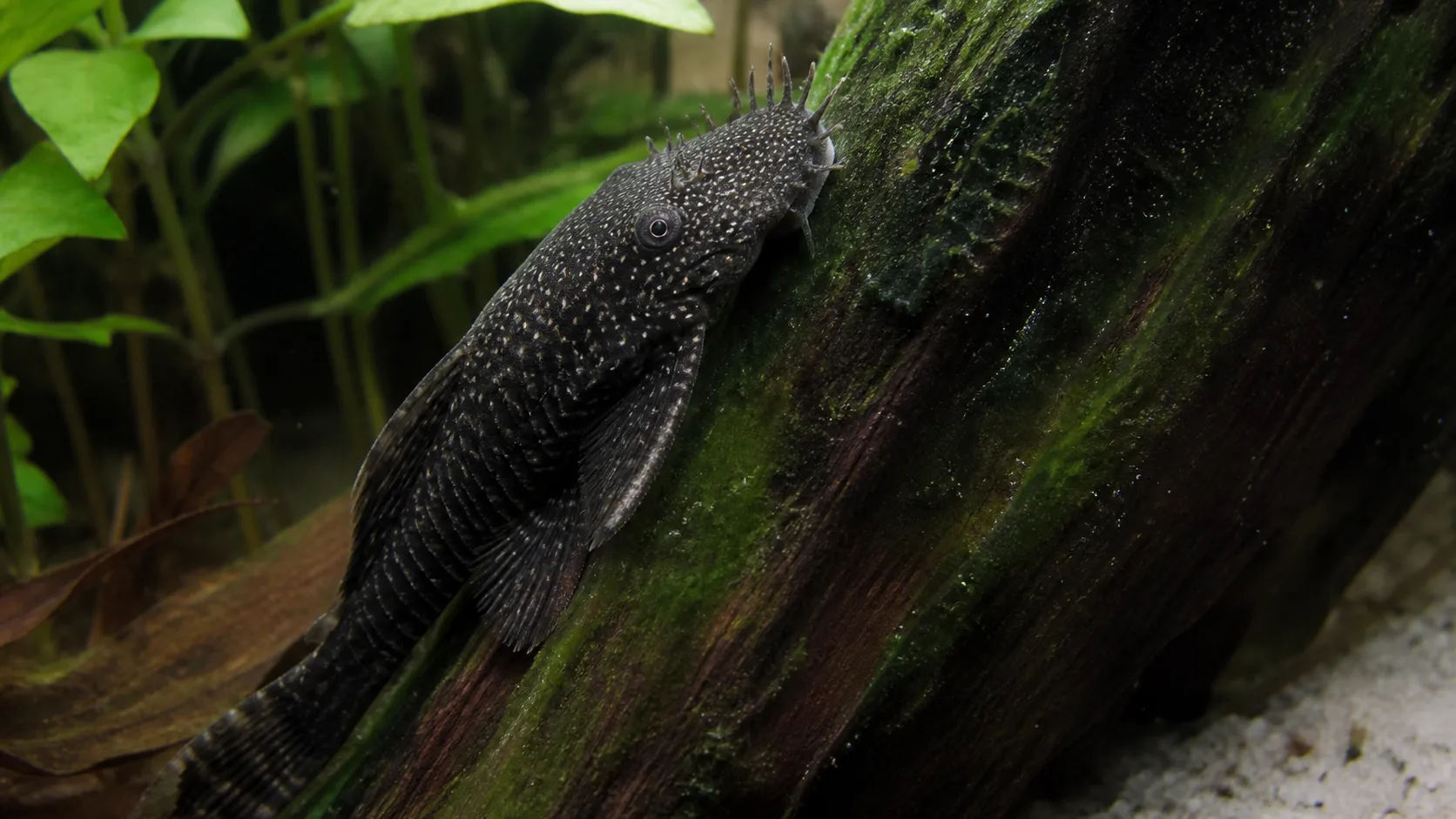
- Bristlenose Pleco — a genuinely effective, low-maintenance diatom and general algae grazer
- Albino Bristlenose Pleco — same grazing behavior, a lighter color variety
A simple algae scraper or pad handles the cosmetic side quickly, while a Bristlenose Pleco provides ongoing grazing pressure that meaningfully slows regrowth once the tank stabilizes and the diatom bloom naturally tapers off.
Black Beard/Brush Algae
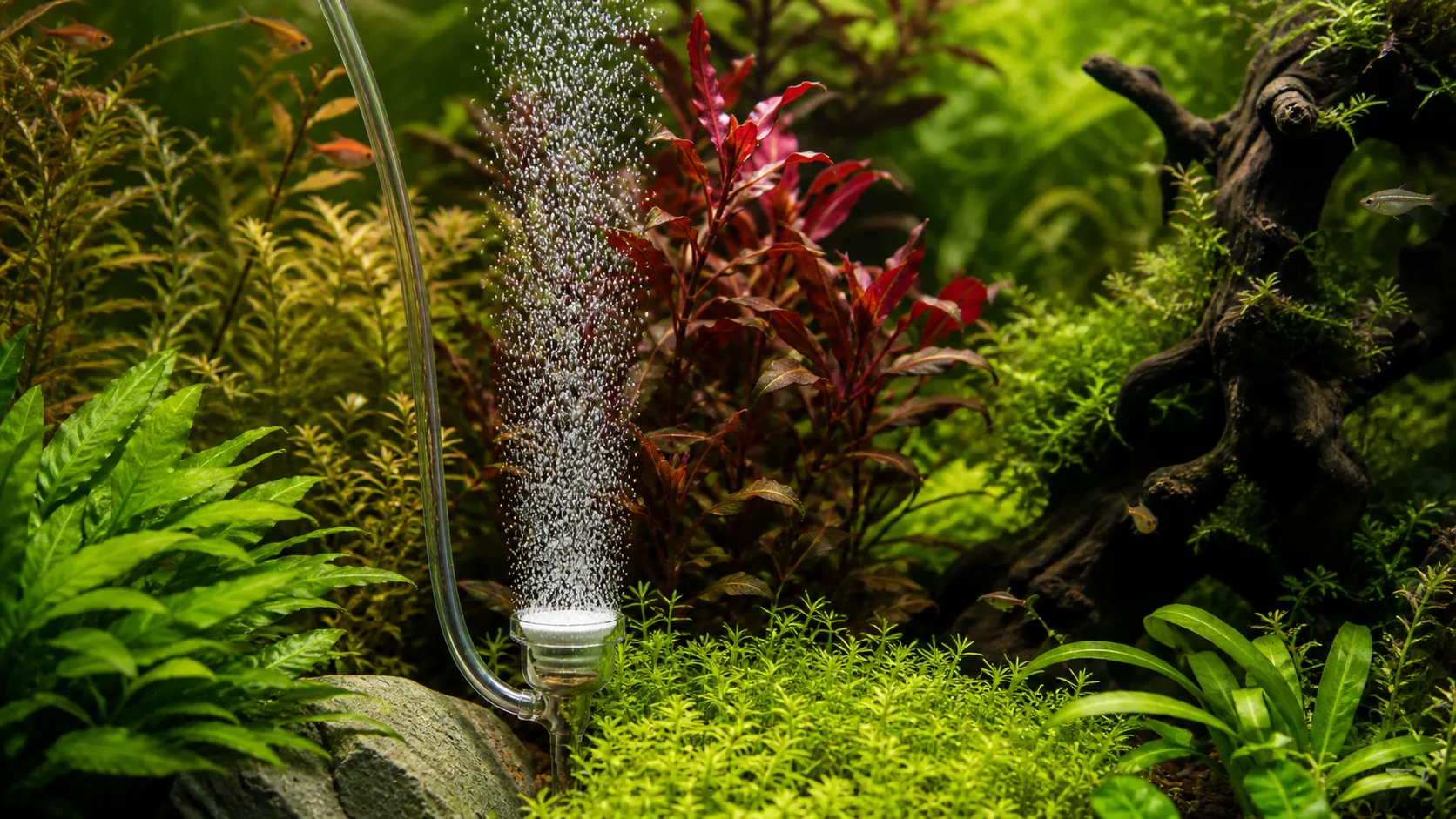
Beyond manual removal (which only slows it, rather than eliminating it, since BBA regrows from any remaining fragment), the real fix is stabilizing CO2 delivery — consistent injection, appropriate for your lighting level, without the swings that let BBA gain a foothold. Our CO2 systems guide covers dialing in a stable, appropriate injection rate.
Green Water (Algae Bloom)
Green water is a free-floating, single-celled algae bloom that turns the entire water column cloudy green rather than growing on a surface, usually triggered by a combination of excess light (especially direct sunlight) and excess nutrients. Unlike surface algae, it can’t be manually scraped away — the fix is addressing the light and nutrient imbalance directly and giving it time to clear.
Blocking direct sunlight, reducing photoperiod, and cutting back on feeding and fertilizing typically resolves a green water bloom within one to two weeks without needing anything more aggressive.
Blue-Green Algae (Cyanobacteria)
Despite the name, blue-green algae is actually photosynthetic bacteria, not true algae — it forms slimy, sheet-like mats with a distinctive musty smell, and typically points to poor water flow or circulation combined with excess organic matter. Because it’s bacterial rather than algae, it responds differently to standard algae fixes and often needs a more thorough manual removal (siphoning out affected areas during a water change) alongside improving flow and reducing excess nutrients.
Biological Control: Real Algae-Eaters
Genuine algae-eating livestock provides ongoing grazing pressure that manual removal and water changes alone can’t match, and it’s a real, sustainable part of long-term algae control rather than a one-time fix.
Recommended Products
- Albino Plecostomus (20cm) — a larger, strong algae grazer suited to bigger tanks
- Garra Rufa (Doctor Fish) — an active grazer that also tolerates a wide parameter range
- Yellow Cherry Shrimp — continuous, low-impact grazing, ideal for smaller and planted tanks
No single species eats every algae type equally well, and biological control works best as a supplement to fixing the underlying light, nutrient, or CO2 imbalance — not a substitute for it. An algae-eater added to a tank that’s still badly out of balance will struggle to keep pace with regrowth.
Healthy Plants Are Your Best Long-Term Defense
Fast-growing, healthy plants and algae are competing for the exact same resources — light, CO2, and nutrients — which is why a tank full of thriving plants tends to stay far more algae-resistant than a sparsely planted one running the same lighting and dosing. Plants that are actually growing well consume nutrients before algae gets the chance, starving out exactly the imbalance that triggers most outbreaks in the first place.
This is also why a struggling, slow-growing plant setup is often more algae-prone than a genuinely low-tech tank with modest lighting and appropriately easy species — pushing more light or nutrients onto plants that aren’t actually using them efficiently just hands algae a bigger opportunity. If you’re fighting recurring algae, it’s worth asking honestly whether your plants are actually thriving or just surviving.
Prevention
- Keep photoperiod to roughly 6–8 hours daily, ideally on a consistent timer
- Avoid overfeeding — uneaten food breaks down into exactly the nutrients algae thrives on
- Match CO2 injection to your lighting level, and keep it stable rather than inconsistent
- Perform regular water changes to keep nutrient levels from building up unchecked
- Avoid direct sunlight hitting the tank, a common and often-overlooked light source
- Add real algae-eating livestock as ongoing biological control, not just a one-time fix
Common Mistakes
- Treating the visible algae without addressing the light, nutrient, or CO2 imbalance driving it
- Increasing light duration or intensity to “help plants outcompete algae” without also correcting nutrients and CO2
- Expecting an algae-eater alone to fix a tank that’s still badly out of balance
- Panicking over normal brown diatom algae in a brand-new tank instead of letting it stabilize
- Only partially removing black beard algae, leaving fragments that regrow
- Ignoring direct sunlight as a light source when troubleshooting an algae outbreak
Frequently Asked Questions
Why does my new tank have brown algae on the glass?
Brown diatom algae is extremely common in new tanks during the first several weeks and is usually a normal part of the tank stabilizing, not a sign of a problem. It typically fades on its own as the tank matures.
What causes black beard algae specifically?
Unstable or insufficient CO2 relative to lighting level is the classic cause. Stabilizing CO2 injection addresses the root cause, alongside manual removal of visible growth.
Will an algae-eating fish or shrimp fully solve my algae problem?
Not on its own if the underlying light, nutrient, or CO2 imbalance isn’t corrected. Biological control works best as a supplement to fixing the actual cause, not a replacement for it.
My water suddenly turned green overnight — what happened?
That’s a green water bloom — a free-floating algae type triggered by excess light (often direct sunlight) and nutrients. Blocking direct light and reducing feeding typically clears it within one to two weeks.
Is blue-green algae actually algae?
No — despite the name, it’s photosynthetic bacteria (cyanobacteria), which is why it often needs a different approach: thorough manual removal plus improving water flow and reducing excess nutrients.
How long should my aquarium lights stay on?
Roughly 6 to 8 hours a day is a reasonable starting point for most planted tanks, ideally on a consistent timer. Longer photoperiods relative to your CO2 and nutrient levels are a common driver of algae outbreaks.
Conclusion
Algae almost always traces back to a real, identifiable imbalance — light, nutrients, or CO2 — and the type you’re seeing usually points to which one. Combine manual removal for an immediate fix, correct the underlying cause so it doesn’t return, and add genuine algae-eating livestock as ongoing biological control rather than a standalone solution.
If you’re dealing with an algae outbreak, explore MyTankScape’s current algae-eating livestock and CO2 equipment to build a tank that stays balanced going forward.
Recommended Products
Internal Link Map
- Bristlenose Pleco
- Albino Bristlenose Pleco
- Albino Plecostomus (20cm)
- Garra Rufa (Doctor Fish)
- Yellow Cherry Shrimp
- CO₂ Systems Explained: Do You Need One?
- Water Parameters 101: Testing pH, Ammonia, Nitrite, and Nitrate
- Shrimp Keeping 101: A Beginner’s Guide to Freshwater Shrimp