 Discus
 Cichlids
 Angelfish
 Plecos & Catfish
 Community & Nano Fish
 Shrimp, Snails & Invertebrates

 Low-Tech Plants
 Medium-Tech plants
 High-Tech Plants
 Live Corals


 Terrarium Kits & Jars
 Terrarium Plants & Moss
 Bioactive Clean-up Crew


 Smart Control Systems
 Lighting
 Filtration
 Heaters
 Chiller & Cooling Fans
 Thermometers
 Air Pumps
 Wavemaker
 Protein Skimmer

 CO2 Diffusers
 CO2 Accessories & Drop Checkers
 Liquid Carbon & CO2 Alternatives





 Soil & Substrate
 Driftwood & Rocks
 Caves & Clays
 Filter Media, Sponge & Replacement Parts
 Tubing & Connectors





How to Cool Your Aquarium in Summer Heat

How to Cool Your Aquarium in Summer Heat
An Egyptian summer is hard on an aquarium. Once room temperatures climb into the high 30s and stay there, an unmanaged tank can drift past 32°C — the point where warm-water fish start to struggle to breathe, plants melt, and a bacterial bloom or ammonia spike becomes far more likely. Cooling a tank isn’t complicated, but it does need a plan before the heat arrives, not during it.
Table of Contents
- Why Heat Is Dangerous — It’s About Oxygen
- Target Temperatures and Warning Signs
- Cooling Fans: The Best Value Fix
- Add Aeration Before You Add Anything Else
- Passive Cooling: Free Things That Work
- Emergency Cooling During a Heatwave
- Managing the Evaporation a Fan Causes
- Which Fish and Plants Handle Heat Best
- Common Summer Cooling Mistakes
- Frequently Asked Questions
Why Heat Is Dangerous — It’s About Oxygen
The single most important thing to understand about aquarium heat is that the danger isn’t the temperature itself — it’s what warm water does to dissolved oxygen. Cooler water holds significantly more oxygen than warm water. As a tank heats up, the amount of oxygen available to your fish drops at exactly the moment their metabolism speeds up and they need more of it.
That’s why the classic sign of an overheated tank is fish gasping at the surface, gathered near the filter outflow where the water is most agitated. They’re not too hot in the way we feel hot — they’re suffocating. Warm water also accelerates ammonia toxicity and can stress the beneficial bacteria colony, so a heat spike often triggers a cascade of other problems. Our water parameters guide covers how those numbers shift under heat.
Target Temperatures and Warning Signs
- 24–27°C: the comfortable range for most tropical community fish.
- 28–30°C: tolerable short-term for hardy species, but stressful if it lasts. Discus and some cichlids are fine here; most tetras, barbs, and shrimp are not thrilled.
- Above 30°C: genuine danger zone. Oxygen is low, stress is high, and disease risk climbs sharply.
- Above 32°C: lethal for many species within hours, especially in a crowded or poorly aerated tank.
The warning signs, in order of severity: fish spending more time near the surface or the filter outflow, faster gill movement, loss of appetite, unusual lethargy, and finally gasping at the surface. Shrimp become sluggish and stop grazing well before fish show obvious signs — they’re a useful early alarm.
Recommended Products
- AT-2 Digital Aquarium Thermometer — an accurate digital readout you can check at a glance; guessing during a heatwave is how fish get lost
- Mini Digital LCD Thermometer — a low-cost second thermometer so every tank in the house is monitored
Cooling Fans: The Best Value Fix
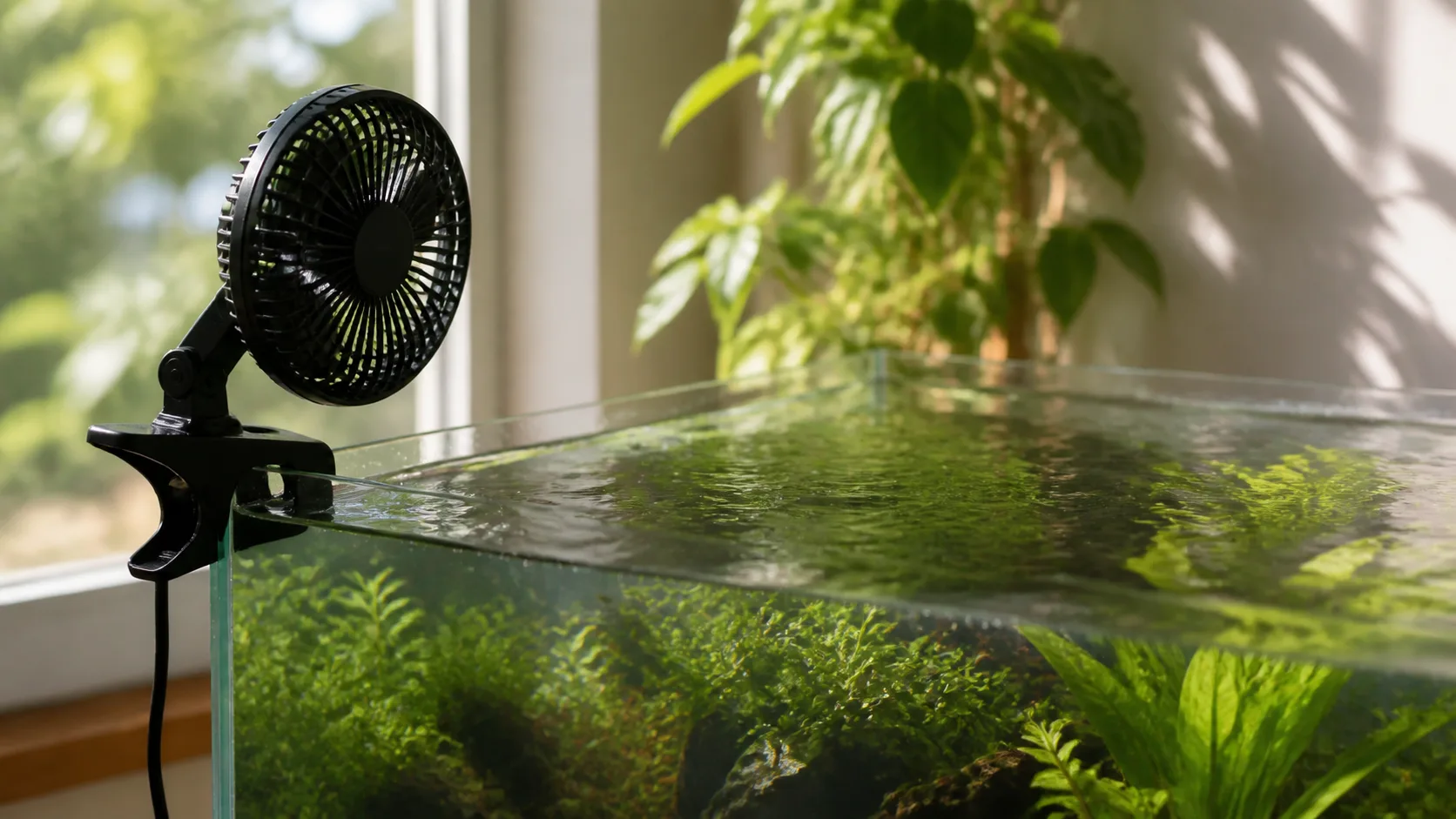
A small fan angled to blow across the water’s surface is the single most cost-effective cooling method there is. It works by speeding up evaporation, and evaporation removes heat — the same reason sweating cools your skin. In a dry Egyptian climate, where the air pulls moisture readily, a surface fan can bring a tank down 2–4°C, sometimes more.
Recommended Products
- Aquarium Cooling Fan Set — clip-on fans designed to mount on the tank rim and angle across the surface; the cheapest real cooling you can buy
- Dual USB Power Adapter — powers USB cooling fans (and other USB accessories) from a single wall socket
A few practical points for using fans well:
- Angle the airflow across the surface, not straight down into the water — you want to move the humid layer of air sitting on top of the tank.
- Take the glass lid off, or prop it open. A sealed lid traps the humid air the fan is trying to clear and kills most of the cooling effect.
- Run the fan on a timer or plug it into the same timer as your lights, so it’s strongest during the hottest part of the day.
- More fans, or a stronger fan, cools more — but also evaporates more. Plan for topping up.
Add Aeration Before You Add Anything Else
Because the real danger of heat is low oxygen, increasing surface agitation is often more urgent than lowering the temperature itself. Before you do anything else during a hot spell:
- Raise your filter outflow so it breaks the surface and creates ripples, or point a spray bar at the surface.
- Add an air stone if you have one — more so in summer than at any other time of year.
- Lower the water level slightly so the filter return splashes down and drags air in.
A well-oxygenated tank at 30°C is far safer than a still tank at 28°C. Get the air in first, then work on the temperature.
Passive Cooling: Free Things That Work
Before spending anything, remove the heat you can:
- Move the tank out of direct sunlight. A tank that catches afternoon sun through a window can gain several degrees on its own, and it grows algae fast on top of that. If you can’t move the tank, close the curtains or shade the window during the hottest hours.
- Turn the aquarium lights off, or run a much shorter photoperiod. LED fixtures add real heat over hours. During a heatwave, 4–5 hours is plenty — the plants will be fine for a week or two.
- Check what else is heating the room. A tank sitting next to a fridge’s exhaust, an oven, a router, or a gaming PC is fighting a losing battle.
- Reduce feeding. Less food means less waste, less oxygen demand from decomposition, and less strain on fish that are already stressed.
- Leave the lid off overnight to let the tank shed heat and take in oxygen while the room is coolest.
Emergency Cooling During a Heatwave
If the tank is already at 31°C or higher and fish are gasping, act now — but gently. A sudden temperature crash is its own emergency and can shock or kill fish faster than the heat would.
- Float sealed bottles of frozen water in the tank. Freeze water in clean plastic bottles and float one or two at a time, swapping them as they thaw. Never tip loose ice or ice made from untreated tap water directly into the tank.
- Do a cool (not cold) water change. A 20–30% change with dechlorinated water a few degrees below the tank temperature helps — but match it carefully. Cold tap water straight in is dangerous.
- Aim for a change of no more than 1–2°C per hour. Slow and steady. The goal is to get out of the danger zone, not to hit the perfect number in ten minutes.
- Keep the fan and air stone running the whole time.
Managing the Evaporation a Fan Causes
Fan cooling works because it evaporates water, so expect the level to drop noticeably — sometimes several centimetres a day on a small tank with a strong fan. That evaporation removes only pure water; the dissolved minerals stay behind, so top-ups need to be pure water too, not more mineral-rich tap water, or your hardness and TDS will creep up over the summer.
- Top up daily with dechlorinated water to keep the level stable — a swinging water level stresses fish and exposes equipment.
- Always treat top-up water with a conditioner first, even though it’s “just a top-up.”
- Watch your water parameters more closely in summer — heat, evaporation, and reduced feeding all shift them.
Which Fish and Plants Handle Heat Best
If summer heat is a yearly battle where you live, it’s worth factoring heat tolerance into what you stock in the first place. Some species genuinely cope better than others.
- More heat-tolerant fish: many livebearers, gouramis, and several barbs handle a warm spell better than most tetras. Discus actually prefer warm water, though they’re demanding in other ways.
- Less heat-tolerant: most tetras and rasboras, and coldwater species like goldfish, which should never share a tropical tank precisely because of temperature.
- Shrimp are among the first to suffer — Neocaridina (cherry-type) shrimp are more forgiving than the sensitive Caridina species, but neither enjoys a sustained 30°C. Our shrimp keeping guide covers their narrower comfort range.
- Plants: hardy low-light species like Anubias, Java fern, and Vallisneria ride out heat better than delicate carpeting plants and fine-leaved stems, which are the first to melt.
Common Summer Cooling Mistakes
- Waiting until fish are already gasping to react, instead of setting up a fan before summer starts.
- Running a fan with the glass lid sealed shut, which cancels most of the cooling.
- Dropping loose ice or untreated-water ice cubes straight into the tank.
- Cooling the tank too fast and shocking the fish.
- Forgetting to top up evaporation, so the water level and hardness both drift.
- Leaving the aquarium light on a full photoperiod through a heatwave.
- Keeping the tank in a spot that gets direct afternoon sun.
Frequently Asked Questions
What temperature is too hot for a freshwater aquarium?
Above 30°C is stressful for most tropical fish, and above 32°C can be lethal within hours, mainly because warm water holds far less oxygen. Aim to keep tropical community tanks at 24–27°C.
How much can a fan cool an aquarium?
A fan blowing across the open water surface typically lowers the temperature 2–4°C, and more in a dry climate. It’s the best value cooling method available and works on tanks of any size.
Can I put ice in my fish tank to cool it down?
Only sealed bottles of frozen water floated in the tank, swapped as they melt. Never add loose ice or ice cubes made from untreated tap water directly — the sudden temperature drop and the chlorine both harm fish.
Why are my fish gasping at the surface in hot weather?
Warm water holds less dissolved oxygen while fish need more of it, so they move to the surface where oxygen exchange is highest. Increase surface agitation and aeration immediately, then work on lowering the temperature slowly.
Should I turn my aquarium heater off in summer?
Leave it plugged in but set it well below the current tank temperature (e.g. 22°C). It won’t switch on while the room is hot, but it protects against a sudden cold night or an over-aggressive cooling effort dropping the tank too far.
How do I cool a tank during a power cut?
Float sealed frozen water bottles, take the lid off, and if you have a battery air pump, run it — oxygen matters more than temperature during an outage. Manually stirring or gently pouring water to break the surface also helps in the short term.
Conclusion
Summer cooling comes down to two things: keep the oxygen up and bring the temperature down slowly. A cheap clip-on fan across an open surface, extra aeration, a shorter light schedule, and daily top-ups will carry most tanks through an Egyptian heatwave without losses. Set it up before the temperature climbs, not after the fish are in trouble.
Pick up a cooling fan and a reliable thermometer from our current stock, and check our water parameters and fish health guides for the problems that heat tends to bring with it.
Recommended Products
Internal Link Map
- Aquarium Cooling Fan Set
- AT-2 Digital Aquarium Thermometer
- Mini Digital LCD Thermometer
- Dual USB Power Adapter
- Water Parameters 101: Testing pH, Ammonia, Nitrite, and Nitrate
- Common Freshwater Fish Diseases and How to Treat Them
- Aquarium Filtration Guide: Choosing the Right Filter