 Discus
 Cichlids
 Angelfish
 Plecos & Catfish
 Community & Nano Fish
 Shrimp, Snails & Invertebrates
 Low-Tech Plants
 Medium-Tech plants
 High-Tech Plants
 Live Corals

 Terrarium Kits & Jars
 Terrarium Plants & Moss
 Bioactive Clean-up Crew


 Smart Control Systems
 Lighting
 Filtration
 Heaters
 Chiller & Cooling Fans
 Thermometers
 Air Pumps
 Wavemaker
 Protein Skimmer

 CO2 Diffusers
 CO2 Accessories & Drop Checkers
 Liquid Carbon & CO2 Alternatives





 Soil & Substrate
 Driftwood & Rocks
 Caves & Clays
 Filter Media, Sponge & Replacement Parts
 Tubing & Connectors





Red Vampire Crab Paludarium Guide: Setup, Care and Feeding

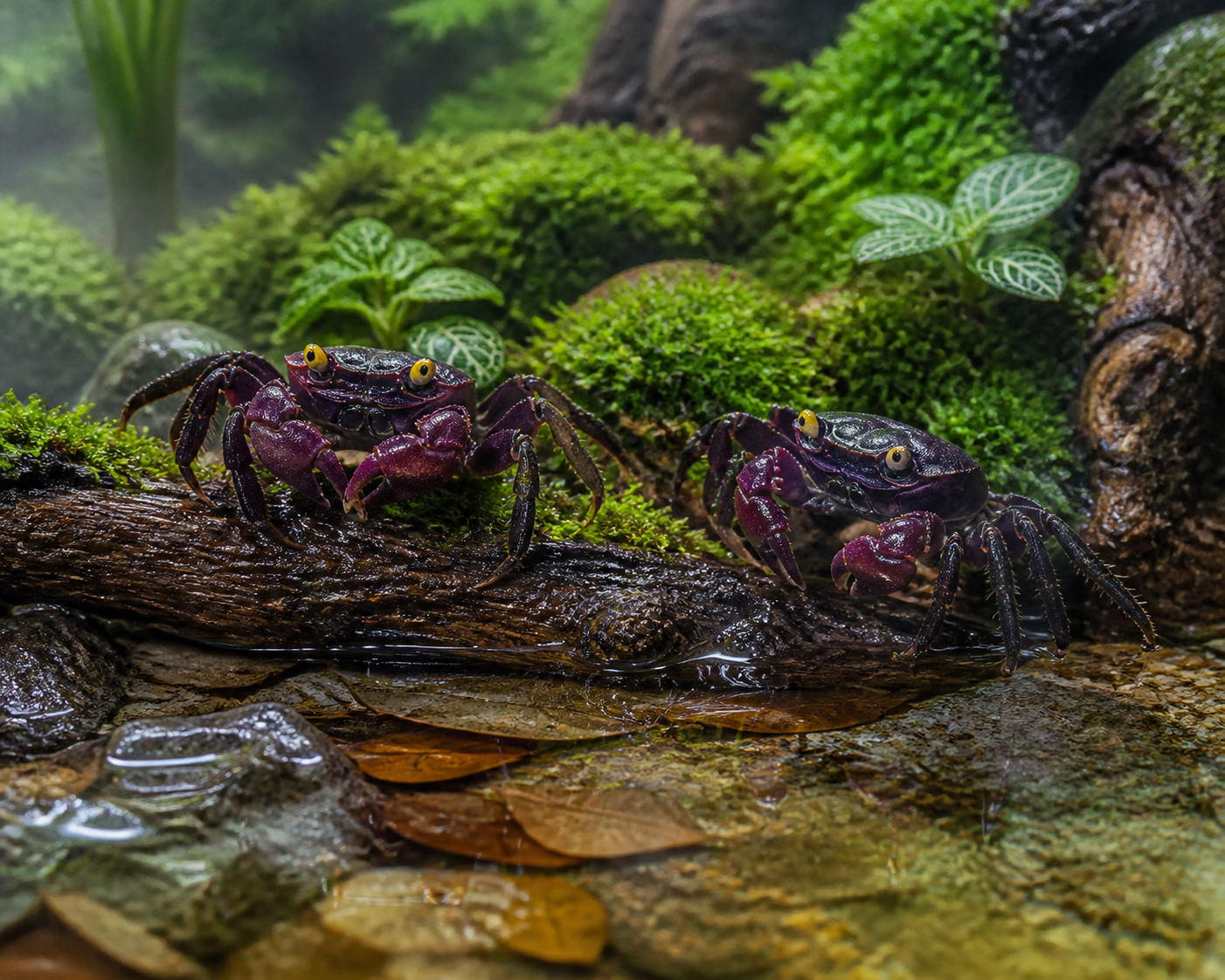
Table of Contents
- Red Vampire Crabs at a Glance
- Why a Paludarium, Not an Aquarium
- Tank Size and the Escape-Proof Lid
- Building the Paludarium Step by Step
- Temperature, Humidity and Water
- Plants and Moss That Survive Crabs
- The Bioactive Cleanup Crew
- Feeding Red Vampire Crabs
- Males, Females and Group Size
- Molting and Breeding
- Can They Live With Fish or Shrimp?
- Common Mistakes
- FAQ
Red Vampire Crab Paludarium Guide: Setup, Care and Feeding
Red Vampire Crabs at a Glance
| Fact | Detail |
|---|---|
| Scientific name | Geosesarma sp. |
| Origin | Rainforest streams and forest floor in Indonesia (Java and nearby islands) |
| Size | Body about 2–3 cm; around 5 cm including legs |
| Lifespan | About 2 years, sometimes a little longer |
| Water type | Fresh water only; no salt needed at any life stage |
| Activity | Most active at dusk and at night; shy at first |
| Care level | Beginner-friendly once the paludarium is set up correctly |
Despite the name, they do not drink blood. “Vampire” comes from the glowing yellow eyes against a dark purple-red body. They are peaceful with people and are best enjoyed as display animals, not pets to handle.
Why a Paludarium, Not an Aquarium
A paludarium is a tank that combines a land section and a water section in one enclosure. Red Vampire Crabs breathe air and spend most of their time on land, climbing and digging. They visit the water to drink, soak and keep their gills moist. In a fully flooded aquarium they can drown, so a normal fish tank is not an option.
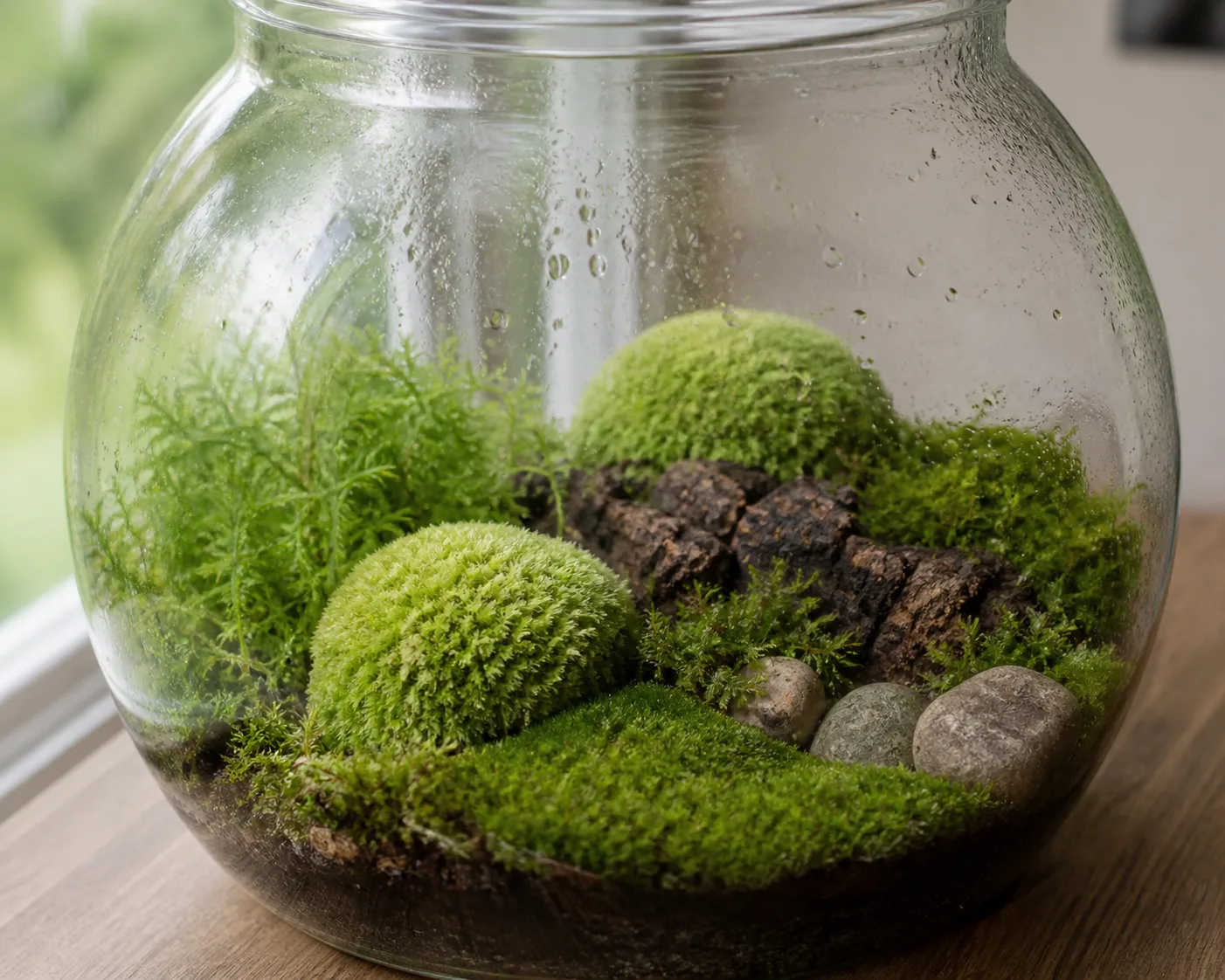
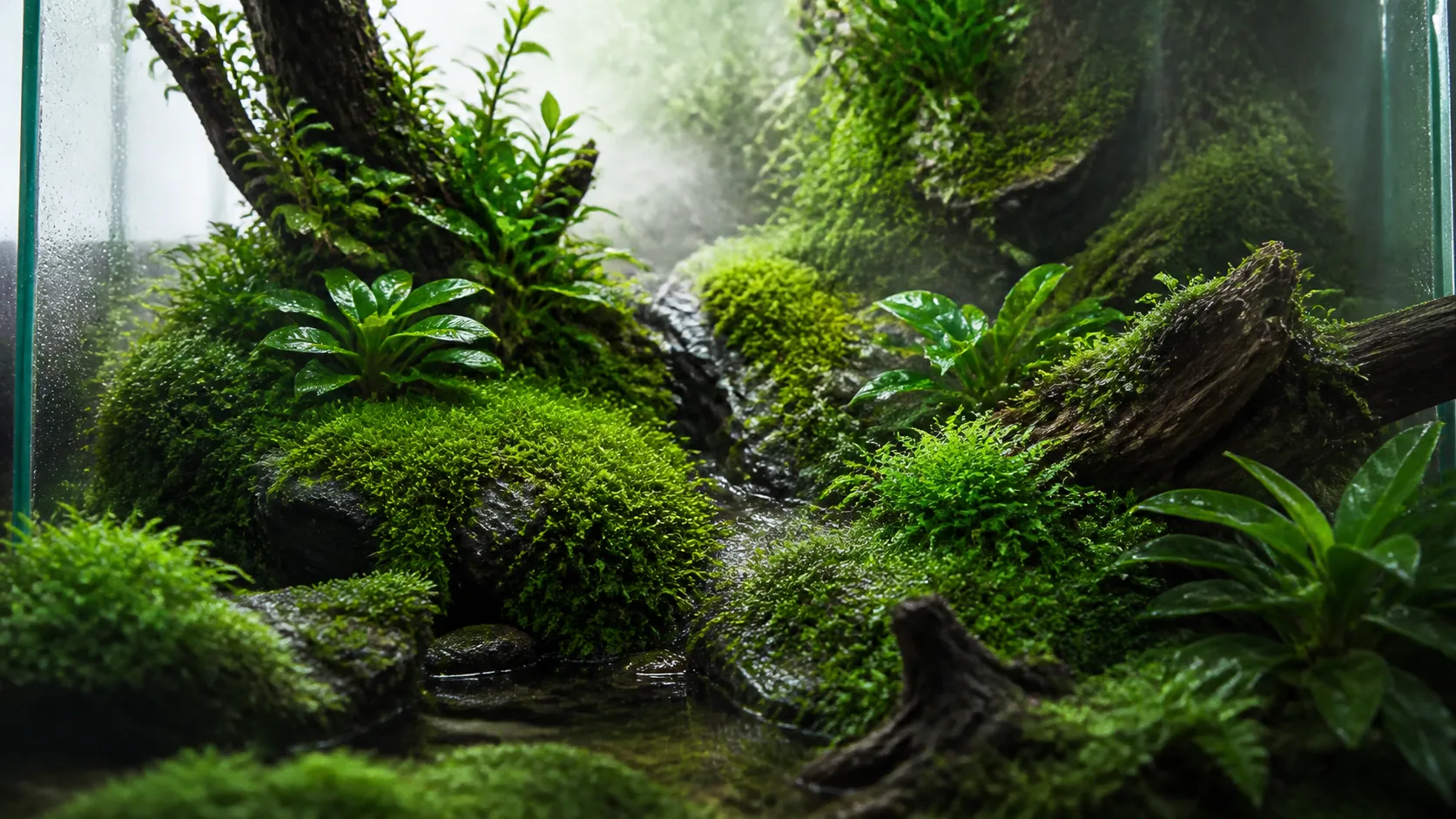
The upside is that a crab paludarium is one of the most beautiful setups you can build: moss-covered wood, small tropical plants, a shallow pool and a misty atmosphere, all in a tank that fits on a desk. If you have ever built a terrarium, you already know half of what you need. Our guide to moss in terrariums and paludariums covers the planting side in more depth.
Tank Size and the Escape-Proof Lid
For a starting group of three or four crabs, a tank of around 40–60 liters works well. A footprint of about 45 × 30 cm or 60 × 30 cm gives enough land to set up a few hiding spots, and a height of 30–40 cm leaves room for wood to climb. Floor space matters more than height, because the crabs live mostly on the ground and the lower branches.
- Ventilation: a small mesh strip in the lid stops the air going stale while still holding humidity.
- Front access: a tank with a front-opening door or a split lid makes misting and feeding easier.
- Custom sizes: paludariums often need a lower front glass or a built-in water section. Our team builds custom aquariums to your exact size.
Building the Paludarium Step by Step
The goal is a land area that stays damp but never waterlogged, and a shallow pool the crabs can walk in and out of without effort.
1. Divide land and water
Plan roughly 60–70% land and 30–40% water. You can build a sloping bank where the substrate runs gently down into the water, or use stones and silicone to make a low wall with a ramp. Keep the water shallow, about 3–6 cm deep, and make sure every edge has an easy way out: a sloping stone, a root or a mat of moss. Crabs must never be trapped in the water.
2. Drainage layer
Under the land section, add 3–5 cm of a coarse drainage layer such as lava rock. Excess water collects here instead of turning the soil into mud, which prevents rot and bad smells. Cover it with a piece of fine mesh so the soil does not wash down into the gaps.
3. Soil and leaf litter
On top of the mesh, add 5–8 cm of a loose, moisture-holding mix: a terrarium soil or coco fiber blended with some sphagnum moss. The crabs love to dig small burrows, so give them depth. Finish with a layer of dry leaves (oak or catappa leaves are popular). Leaves give the crabs cover, food for the cleanup crew and a natural look.
4. Hardscape and hides
Add a piece of driftwood or a root that reaches from the water up onto the land, and a few stones such as dragon stone to create caves and ledges. Each crab should have at least one hiding place of its own: cork bark, half coconut shells, stacked stones or hollow wood all work. Our article on using driftwood and rocks in a natural scape explains how to place hardscape so it looks natural and stays stable.
5. Plant, mist and wait
Plant the land, attach moss to the wood, fill the water section with dechlorinated water and mist the whole tank. Then let it run for one to two weeks before adding crabs. This gives plants time to root, lets you check that humidity and temperature stay steady, and allows a little biofilm to form in the water section.
Temperature, Humidity and Water
| Parameter | Target |
|---|---|
| Air and water temperature | 24–28°C |
| Humidity | About 70–80% |
| Water | Fresh, dechlorinated, no salt |
| pH | Around neutral, about 6.5–7.5 |
| Water depth | Shallow, about 3–6 cm |
Humidity is the number most beginners get wrong. Mist the tank once or twice a day with dechlorinated water, and keep a small hygrometer inside so you are not guessing. The glass should look slightly misted, but water should not pool on the land. An ultrasonic fog maker placed in the water section adds a beautiful rainforest mist and helps hold humidity, but run it on a timer for short periods rather than all day, or the land becomes soggy.
Temperature: in a Cairo summer most rooms already sit in the right range, so watch for overheating rather than cold. Keep the tank out of direct sun and away from closed, hot rooms. In winter, many homes drop below 22°C at night. A small heater in the water section, such as the Xilong XL-601 USB mini heater, warms the pool and the air above it. Make sure the water is deep enough to cover the heater fully, as its instructions require. Our aquarium heater guide covers safe placement.
Plants and Moss That Survive Crabs
Red Vampire Crabs pick at soft leaves and dig around roots, so choose sturdy plants that like humidity and moderate light.
- Fittonia (nerve plant): loves high humidity and adds color. Try Fittonia ‘Red’ next to green moss for contrast.
- Anubias and Java Fern: tough leaves that crabs leave alone. Tie them to wood at the water line so their roots reach the water. Anubias Nana Petite suits small tanks, and Java Fern grows happily half in and half out of water.
- Land moss: Cushion Moss and Forest Moss carpet the land and hold moisture.
- Water-edge moss: Christmas Moss on stones or wood at the water line softens the edge and gives the crabs grip when climbing out.
- Hydrocotyle tripartita: grows both submerged and emersed, and spreads nicely along the bank.
For moss that stays green rather than turning brown, see our terrarium moss care guide. A simple LED light on an 8–10 hour timer is enough for these plants; the crabs themselves need no special lighting.
The Bioactive Cleanup Crew
A bioactive paludarium uses tiny helpers to eat leftover food, mold and dead leaves before they rot. It is the single easiest way to keep a crab tank clean and smelling fresh.
- Springtails: very small insects that eat mold and fungus. A pinecone with live springtails placed on the soil spreads a colony through the tank.
- Isopods: woodlice (isopods) break down leaf litter and leftover food deeper in the soil.
The crabs may hunt a few of them, and that is fine; it is natural extra protein. Add the cleanup crew during the one-to-two-week settling period so the colonies are established before the crabs arrive.
Feeding Red Vampire Crabs
These crabs are omnivores and scavengers. In the wild they eat small insects, fallen fruit and decaying plant matter, so variety matters more than any single food.
- Staple: a sinking crab or invertebrate food such as Hikari Crab Cuisine, a few pellets per crab.
- Protein: frozen bloodworms or brine shrimp, or small live insects such as fruit flies, once or twice a week.
- Plant food: small pieces of blanched zucchini, spinach or cucumber, and an occasional bite of banana or mango.
- Insect-based pellets: Fluval Bug Bites make a good change from the staple.
Feed a small pinch every day or every other day, ideally in the evening when the crabs are active. Place food on a flat stone or a small dish on land so it is easy to find and easy to remove. Take out anything uneaten after 24 hours to prevent mold.
Males, Females and Group Size
Males and females are easy to tell apart once you know what to look for. Look at the flap under the body: males have a narrow, triangular flap, while females have a wide, rounded flap that covers most of the underside, where they carry eggs. Males also tend to have larger, more colorful claws.
Males are territorial with each other. Keep one male with two or three females in a 40–60 liter tank. If you want two males, give them a larger tank with plenty of hides and visual barriers so they each have their own corner.
Molting and Breeding
Like all crabs, Red Vampire Crabs grow by shedding their shell. Before a molt, a crab hides and eats less for a few days. Afterwards you may find what looks like a dead crab: it is usually the empty shell. Leave the old shell in the tank; the crab often eats it to recover calcium. Do not handle or disturb a freshly molted crab, as its new shell stays soft for a few days.
Breeding is one of the most rewarding things about this species. Unlike many crabs that need salt water for larvae, Geosesarma females carry their eggs under the abdomen and release tiny, fully formed baby crabs directly into fresh water. A berried female hides more than usual, so give her space and keep humidity steady. The babies hide in moss and leaf litter and eat biofilm and crumbs, and the adults may eat some of them, so a dense moss carpet improves survival.
Can They Live With Fish or Shrimp?
Most keepers give Red Vampire Crabs their own tank, and that is our recommendation. Their water section is too shallow for most fish, and the crabs are quick hunters at night.
- Shrimp: adult cherry shrimp may survive, but baby shrimp are likely to be eaten. Our shrimp keeping guide covers shrimp-only tanks instead.
- Small fish: fish that stay near the surface in a larger water section can coexist, but sleeping fish near the bottom may be caught.
- Other crab species: do not mix species; they fight and may hybridize.
Common Mistakes
- Using a normal aquarium: crabs need land and can drown without it.
- Gaps in the lid: the most common way to lose crabs.
- Deep water with no way out: keep the pool shallow with easy ramps.
- Letting the tank dry out: low humidity causes failed molts.
- Soggy, rotting soil: always use a drainage layer and do not over-run the fogger.
- Untreated tap water: dechlorinate everything, including spray water.
- Overfeeding: leftover food grows mold quickly in a humid tank.
- Too many males: one male per small group keeps the peace.
Frequently Asked Questions
No. They are freshwater crabs at every stage of life, and their babies hatch fully formed in fresh water.
No. They spend most of their time on land and can drown in a fully flooded tank. They need a paludarium with land and shallow water.
The body reaches about 2–3 cm, and around 5 cm including the legs.
One male with two or three females in a 40–60 liter paludarium is a good start.
A varied diet: crab pellets, frozen bloodworms, small insects, blanched vegetables and occasional fruit, fed every day or two.
They are naturally shy and most active at night. A crab that hides for several days may also be getting ready to molt or carrying eggs.
Adult shrimp sometimes survive, but baby shrimp are likely to be eaten. A species-only tank is safest.
Conclusion
A Red Vampire Crab paludarium is a small tank with a big personality: a misty corner of rainforest on your desk, with jewel-colored crabs climbing through the moss at night. Get the lid, the humidity and the shallow water right, and you will have a thriving, breeding colony that is genuinely easy to look after. If you would like help choosing a tank or planning the layout, our team is happy to help.
Recommended Products
- Red Vampire Crab (Geosesarma sp.)
- Hikari Crab Cuisine
- Ultrasonic Fog Maker
- Pinecone with Live Springtails
- Cushion Moss
- Sphagnum Moss