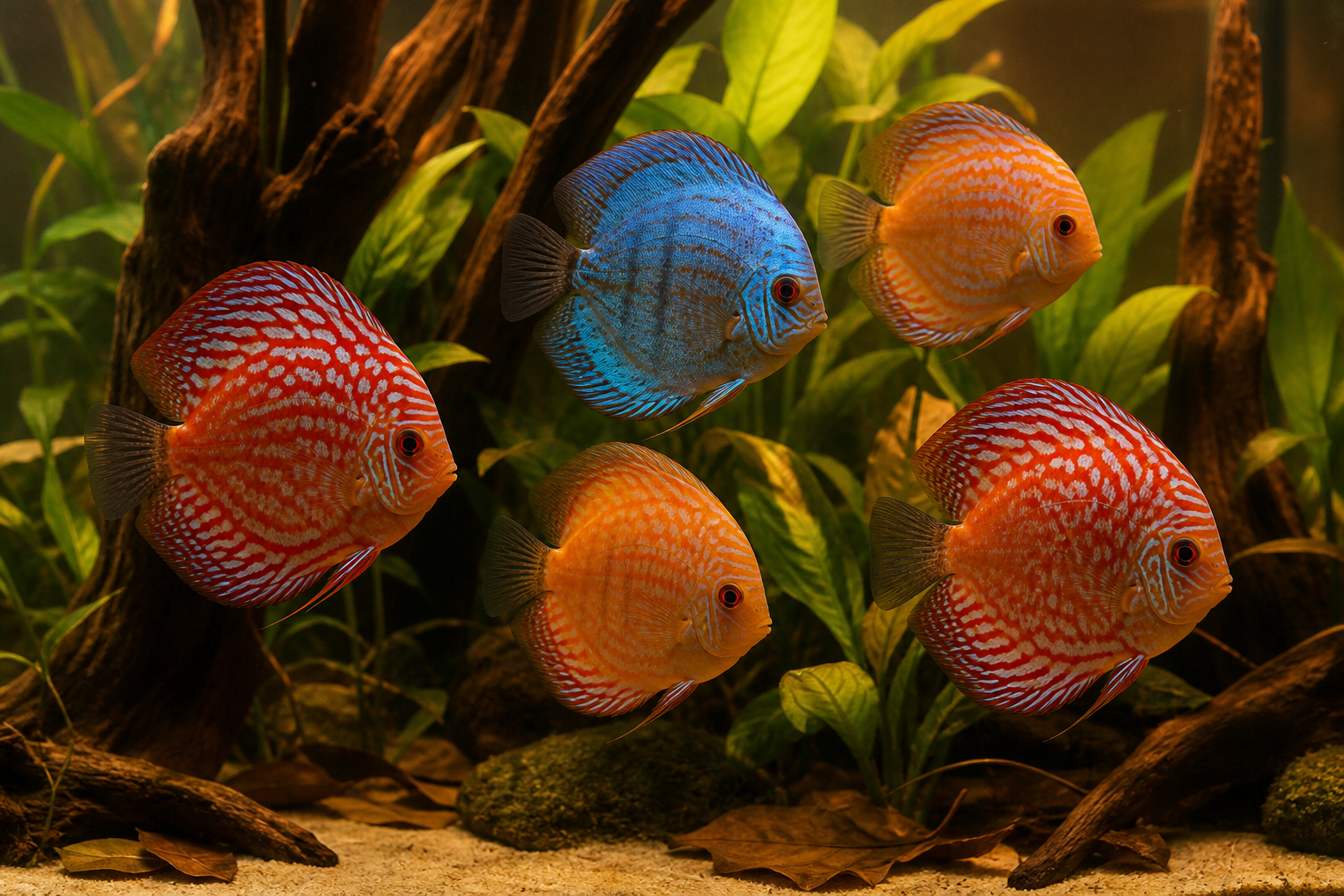
 Discus
 Cichlids
 Angelfish
 Plecos & Catfish
 Community & Nano Fish
 Shrimp, Snails & Invertebrates

 Low-Tech Plants
 Medium-Tech plants
 High-Tech Plants
 Live Corals


 Terrarium Kits & Jars
 Terrarium Plants & Moss
 Bioactive Clean-up Crew


 Smart Control Systems
 Lighting
 Filtration
 Heaters
 Chiller & Cooling Fans
 Thermometers
 Air Pumps
 Wavemaker
 Protein Skimmer

 CO2 Diffusers
 CO2 Accessories & Drop Checkers
 Liquid Carbon & CO2 Alternatives





 Soil & Substrate
 Driftwood & Rocks
 Caves & Clays

 Filter Media, Sponge & Replacement Parts
 Tubing & Connectors





Angelfish Care Guide: Tank Setup, Tankmates and Feeding

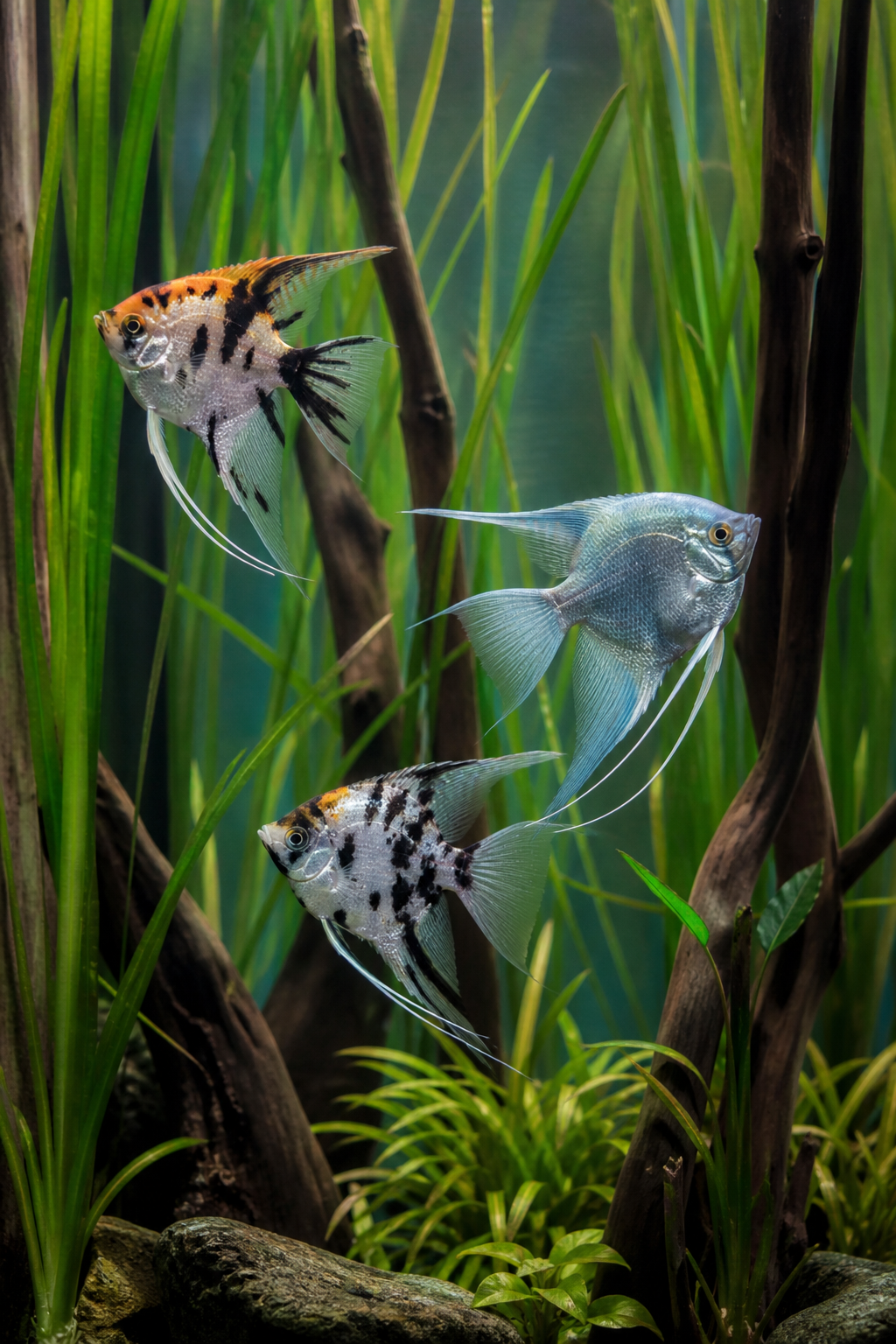
Table of Contents
- Angelfish at a Glance
- Tank Size and Shape
- Water Parameters
- Plants and Decor
- Popular Angelfish Varieties
- How Many Angelfish to Keep
- Tankmates: What Works
- Feeding Angelfish
- Pairs and Breeding Behaviour
- Choosing and Bringing Home New Angelfish
- Health Signs to Watch
- Common Angelfish Mistakes
- FAQ
Angelfish Care Guide: Tank Setup, Tankmates and Feeding
Angelfish at a Glance
| Fact | Detail |
|---|---|
| Origin | Amazon Basin, South America |
| Adult size | Around 15 cm long and taller than that with fins |
| Lifespan | Up to about 10 years with good care |
| Temperament | Mostly peaceful; territorial when pairing and breeding |
| Care level | Beginner to intermediate, in a mature tank |
The angelfish you buy are usually juveniles of a few centimeters. That is exactly why so many end up in tanks that are too small a year later. Plan the tank for the adult.
Tank Size and Shape
Height matters as much as volume. Angelfish grow tall, so choose a tank at least about 45 cm high, and allow roughly 100 liters for a pair, with more space for a group of young fish that will later pair off. A longer tank also gives a breeding pair room to claim territory without bullying everyone else.
- Gentle flow: those long fins are not built for strong current.
- A fully cycled tank: add angels to a mature tank, not a new one. Our nitrogen cycle guide explains how.
- A lid: angels rarely jump, but a cover reduces evaporation and keeps temperature stable.
Water Parameters
| Parameter | Target |
|---|---|
| Temperature | 24–29°C |
| pH | About 6.0–7.5 |
| Hardness | Soft to moderately hard, about 3–8 dGH |
| Ammonia and nitrite | Zero |
| Nitrate | Keep it low with regular water changes |
Most captive-bred angels adapt well to a stable pH within that range, so do not chase a number. Change about 25–30% of the water every week, and treat new water with a conditioner. See Water Parameters 101 for testing and our water change guide for the routine.
Plants and Decor
Angelfish come from slow, plant-filled waters and feel safest among tall stems and vertical wood. Leave open water in the middle for swimming.
- Tall background plants and vertical driftwood recreate their natural habitat and give them cover.
- Broad leaves are where a pair will often lay its eggs.
- Tannins from Indian almond leaves give the water a soft amber tint and a more natural feel.
Popular Angelfish Varieties
All the colour forms below are the same species, Pterophyllum scalare, so they share the same care and can live together.
Koi Angelfish – Orange, Black and White
A marbled mix of orange, black and white that varies from fish to fish. The Yellow Head Koi adds a bright golden head.
Blue Diamond – Blue Shine with Age
Young fish look plain, but the blue colouring develops as they mature.
Bulgarian and Leopard – Classic Patterns
Bulgarian angels show soft, elegant markings, while Leopard angels are covered in dark spots.
Super Red Devil Longfin – Flowing Fins
Longfin forms have extra-long, trailing fins. They are beautiful but even more vulnerable to fin-nippers.
How Many Angelfish to Keep
Angelfish are social when young and more territorial as adults. The most reliable approach is to buy a group of five or six juveniles in a large enough tank and let them pair off naturally. Once a pair forms, it may claim part of the tank; in a smaller tank, you may need to rehome the extra fish.
- A single angel is fine in a community tank and avoids pairing aggression.
- A known pair works well in a 100-liter tank.
- Three or four adults in a small tank is where most fighting happens.
Tankmates: What Works
Good angelfish tankmates are peaceful, not too small, and not interested in long fins.
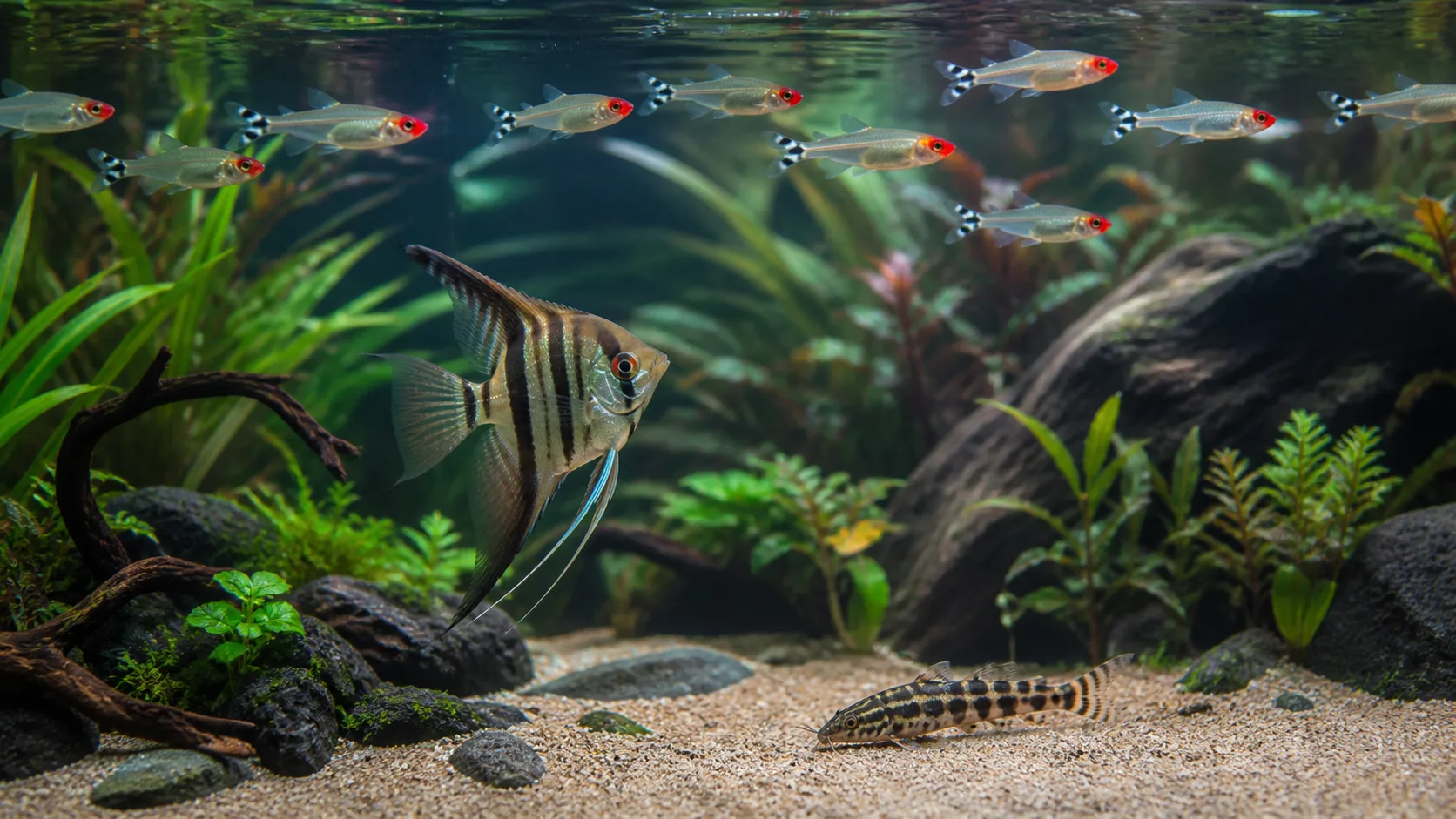
- Bottom dwellers: bristlenose plecos and corydoras keep to the bottom and stay out of the angels’ way.
- Medium tetras in groups: Rummy Nose tetras work well, especially if they are added before the angels grow large.
- Other calm, mid-sized community fish with similar water needs.
- Avoid: fin-nippers such as tiger barbs, and very small fish like tiny tetras or shrimp, which adult angels may eat.
Feeding Angelfish
Angelfish eat both prepared and meaty foods. Feed once or twice a day, only what they finish in about two minutes, and offer variety through the week.
- Staple: a quality pellet or stick sized for their mouths.
- Variety: foods that mimic live prey, plus frozen bloodworm or brine shrimp if you use them.
- Bottom fish: make sure some food reaches the plecos and corydoras too.
Pairs and Breeding Behaviour
A pair usually announces itself: two fish stay together, clean a broad leaf, a piece of slate or the glass, and chase other fish away from that spot. The female lays rows of eggs and both parents fan and guard them.
- Expect territory: breeding pairs become much more defensive, which can stress tankmates in a small tank.
- Early spawns often fail: young pairs commonly eat their first eggs and improve with practice.
- Raising fry is easiest in a separate tank with very gentle filtration.
Choosing and Bringing Home New Angelfish
Healthy young angels are alert, swim upright with fins held open, and come forward when food appears. Avoid fish that hang at the surface, hide in a corner with clamped fins, or show white spots or torn fins.
- Prepare the tank first: it should be fully cycled, heated and stable before the fish arrive.
- Float the bag for about 15–20 minutes so the temperature matches.
- Add tank water to the bag gradually over 20–30 minutes so the fish adjust to your water.
- Net the fish into the tank and throw away the bag water.
- Keep the lights low for the rest of the day and feed lightly the next day.
Health Signs to Watch
| What you see | Likely cause | First step |
|---|---|---|
| Frayed or torn fins | Fin-nipping tankmates or poor water | Watch the tank, test the water, separate the nipper |
| White spots like salt grains | White spot disease (ich) | Treat the whole tank, following the product directions |
| Hiding, dark colour, not eating | Stress, bullying or water quality | Test the water and look for an aggressive tankmate |
| Fast breathing at the surface | Low oxygen or ammonia | Change water and add surface movement |
Warm water holds less oxygen, so in hot weather keep the tank below about 29°C; our summer cooling guide explains how.
Common Angelfish Mistakes
- A tank that is too short or too small for the adult fish.
- Housing them with fin-nippers, which shred their long fins.
- Adding tiny fish that become food as the angels grow.
- Keeping three or four adults together in a small tank, which leads to fighting once pairs form.
- Skipping water changes, which shows first as frayed fins and dull colour.
If you see clamped fins, white spots or frayed edges, check your water first and then read our fish diseases guide.
Frequently Asked Questions
Around 15 cm long, and taller than that including their fins, so they need a tall tank.
Roughly 100 liters for a pair, at least about 45 cm high, and more for a group.
Yes, with medium tetras such as Rummy Nose in a group. Very small tetras may be eaten by adult angels.
Mostly peaceful, but pairs become territorial when they breed, especially in small tanks.
Once or twice a day, only what they eat in about two minutes, with variety through the week.
Yes. Koi, Blue Diamond, Bulgarian, Leopard and Longfin forms are all the same species.
Not reliably. Adult angels see small shrimp as food.
Conclusion
Give angelfish height, gentle flow, clean water and peaceful tankmates that are not bite-sized, and they become the calm centrepiece of a planted tank for years.
Recommended Products
- Yellow Head Koi Angelfish
- Blue Diamond Angelfish
- Longfin Albino Bristlenose Pleco
- Royal King Angelfish Food
- Jeneca LT-600 Hang-On Filter
- Java Fern