
 Discus
 Cichlids
 Angelfish
 Plecos & Catfish
 Community & Nano Fish
 Shrimp, Snails & Invertebrates

 Low-Tech Plants
 Medium-Tech plants
 High-Tech Plants
 Live Corals

 Terrarium Kits & Jars
 Terrarium Plants & Moss
 Bioactive Clean-up Crew


 Smart Control Systems
 Lighting
 Filtration
 Heaters
 Chiller & Cooling Fans
 Thermometers
 Air Pumps
 Wavemaker
 Protein Skimmer

 CO2 Diffusers
 CO2 Accessories & Drop Checkers
 Liquid Carbon & CO2 Alternatives





 Soil & Substrate
 Driftwood & Rocks
 Caves & Clays
 Filter Media, Sponge & Replacement Parts
 Tubing & Connectors





Aquatic Turtle Care Guide: Red-Eared Slider, Softshell and African Sideneck

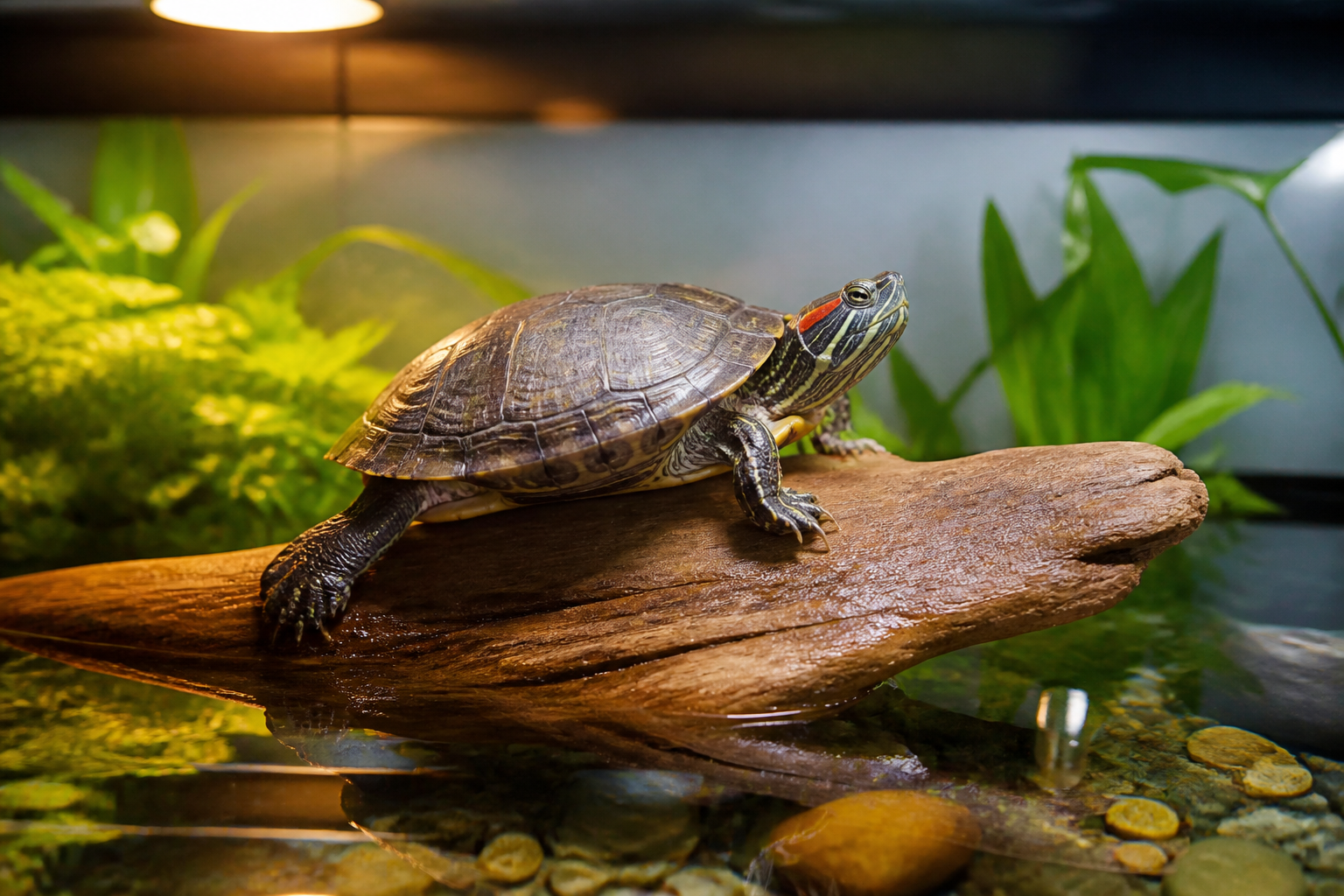
Table of Contents
- Three Popular Aquatic Turtles Compared
- Before You Buy: The Commitment
- Tank Size and Setup
- Basking Area, Heat and UVB
- Water, Filtration and Heating
- Feeding Your Turtle
- Weekly Care Routine
- Health Warning Signs
- Hygiene and Responsible Ownership
- FAQ
Aquatic Turtle Care Guide: Red-Eared Slider, Softshell and African Sideneck
Three Popular Aquatic Turtles Compared
| Turtle | Lifestyle | Lifespan | Key needs |
|---|---|---|---|
| Red-eared slider | Semi-aquatic, basks often | 20–40 years | Large water area, basking spot, UVB, varied diet |
| Softshell turtle | Highly aquatic, fast and active | Decades with good care | Soft sand, very clean water, no sharp decor, lots of space |
| African sideneck | Semi-aquatic, curious | Up to 50 years | Big tank, dry basking area, UVB, no small gravel |
Red-Eared Slider – The Classic Pet Turtle
The red-eared slider (Trachemys scripta elegans) is named for the red stripe behind each eye. It is hardy and sociable with its keeper, but it is a long-term pet that can live 20–40 years. Adults commonly reach 13–16 cm and older females can grow larger, so the tank has to grow with it. Sliders want water at 24–27°C and a basking spot at 32–35°C under UVB.
Softshell Turtle – The Fast Swimmer
Softshell turtles (Apalone) have a flat, leathery shell instead of hard scutes and spend most of their time in the water, often buried in sand with only the snout showing. They are quick, can bite hard, and their soft shell scratches easily, so they need fine sand, smooth decor and very clean water at about 22–26°C. They are sold small but grow considerably, so they suit keepers who can provide a large tank later.
African Sideneck – The Curious One
The African sideneck (Pelusios castaneus) folds its neck sideways under the shell instead of pulling it straight back. It is hardy and often described as beginner-friendly, but it needs plenty of room: a tank of roughly 340–415 liters for an adult. It is best kept one per enclosure to avoid aggression, and it can live up to 50 years. Avoid small gravel, which it may swallow.
Before You Buy: The Commitment
- Decades, not years: plan for 20–50 years of care, including who looks after the turtle when you travel.
- Space grows with the turtle: a hatchling tank is temporary. Budget for a larger tank as it grows.
- Turtles are messy: they eat and produce far more waste than fish of the same size, so filtration and water changes matter.
- Usually one per tank: many turtles become territorial, especially in a small space.
Tank Size and Setup
A widely used rule of thumb is about 15 liters of water per centimeter of shell length. A 10 cm turtle therefore needs roughly 150 liters, and a 15 cm adult roughly 225 liters. More is always better, and water depth should be at least about one and a half times the turtle’s shell length so it can turn over easily.
- Swimming area: long and wide matters more than tall; turtles swim across the tank, not up and down.
- Dry land: a stable basking platform the turtle can climb onto fully and dry off on.
- Substrate: bare bottom is easiest to clean. If you use substrate, choose either fine sand (essential for softshells) or stones too large to swallow.
- Secure lid or high sides: turtles climb better than you expect.
Basking Area, Heat and UVB
Basking is not optional. Turtles climb out to warm up, digest food and dry their shell, which helps prevent shell infections. Under the lamp, the basking spot should reach about 32–35°C, while the water stays cooler at about 24–27°C, so the turtle can move between the two.
- UVB is essential: it lets the turtle make vitamin D3 and absorb calcium. Without it, the shell and bones weaken over time.
- Place the lamp safely: above the basking spot, out of reach and away from splashes.
- Run it on a timer: around 10–12 hours a day gives a steady day-night rhythm.
- Replace UVB lamps as the maker advises: UV output fades long before the visible light does.
Water, Filtration and Heating
Turtles produce a lot of waste, so filtration needs to be generous. Choose a filter rated for two to three times your actual water volume. Canister and strong hang-on-back filters both work, as long as they can be cleaned easily.
- Treat new water with a water conditioner before it goes in.
- Heat the water to about 24–27°C for sliders and sidenecks, or about 22–26°C for softshells.
- Protect the heater: turtles knock things over. A stainless-steel heater or a heater guard prevents breakage.
- Change part of the water weekly: roughly 25–50%, depending on how dirty it gets.
Our filtration guide and heater guide explain sizing in more detail.
Feeding Your Turtle
Most aquatic turtles eat both animal and plant food, and young turtles eat more protein than adults.
- Staple: a commercial turtle pellet made for aquatic turtles, sized for your turtle’s mouth.
- Greens: leafy greens and aquatic plants, especially for adult sliders.
- Protein treats: insects, worms or small pieces of fish, in moderation. Softshells are more carnivorous and enjoy worms and live invertebrates.
- Calcium: together with UVB, calcium keeps the shell hard.
- How much: juveniles daily, adults every second or third day; remove uneaten food quickly.
Weekly Care Routine
- Daily: check the water and basking temperatures, feed, and remove leftovers.
- Weekly: change 25–50% of the water with conditioned water and wipe the basking area.
- Every few weeks: rinse the filter media in removed tank water, never under the tap.
- Every few months: check the UVB lamp’s age and replace it as the maker advises.
For the general principles of water changes, see How Often Should You Change Your Aquarium Water?
Health Warning Signs
- Swollen or closed eyes: often linked to poor water or diet. Improve both and seek advice.
- Soft or deformed shell: usually missing UVB or calcium.
- White patches, pits or a bad smell from the shell: possible shell infection; dry basking and clean water help prevent it.
- Floating lopsided, wheezing or bubbles from the nose: possible respiratory infection, often from water that is too cold.
- Not eating for a long time: check temperatures first.
Hygiene and Responsible Ownership
- Wash your hands with soap after handling a turtle or its water. Turtles can carry Salmonella, so supervise young children.
- Keep turtle equipment separate from the kitchen sink and food areas.
- Never release a turtle into the Nile, canals, lakes or any natural water. Released pet turtles harm native wildlife and rarely survive well. If you cannot keep your turtle, ask us about rehoming it.
Frequently Asked Questions
A common guide is about 15 liters of water per centimeter of shell length, planned for the adult size. The African sideneck needs roughly 340–415 liters as an adult.
Yes. Basking heat helps digestion and keeps the shell dry, and UVB lets the turtle absorb calcium for a healthy shell.
About 24–27°C for sliders and sidenecks, about 22–26°C for softshells, with a basking spot of about 32–35°C.
Red-eared sliders 20–40 years, and African sidenecks up to 50 years with good care.
Turtles usually eat or chase small fish, and their waste is hard on fish. A turtle-only tank is the safest choice.
It depends on the species and space. Many turtles become territorial, and the African sideneck is best kept alone.
It is more demanding than a slider: it needs soft sand, very clean water and a lot of space as it grows, and it can bite hard.
Conclusion
Water to swim in, a warm dry place to bask, UVB light, strong filtration and a varied diet: give a turtle those five things and plan for the adult, and it can be with you for decades.
Recommended Products
- 50 cm Aquatic Turtle Tank
- Aquanature Boshi UVB+UVA Halogen Lamp
- Jeneca LT-600 Hang-On Filter
- XiLong L-399 Stainless Steel Heater
- 20 cm Aquarium Tweezers
- Seachem Safe


